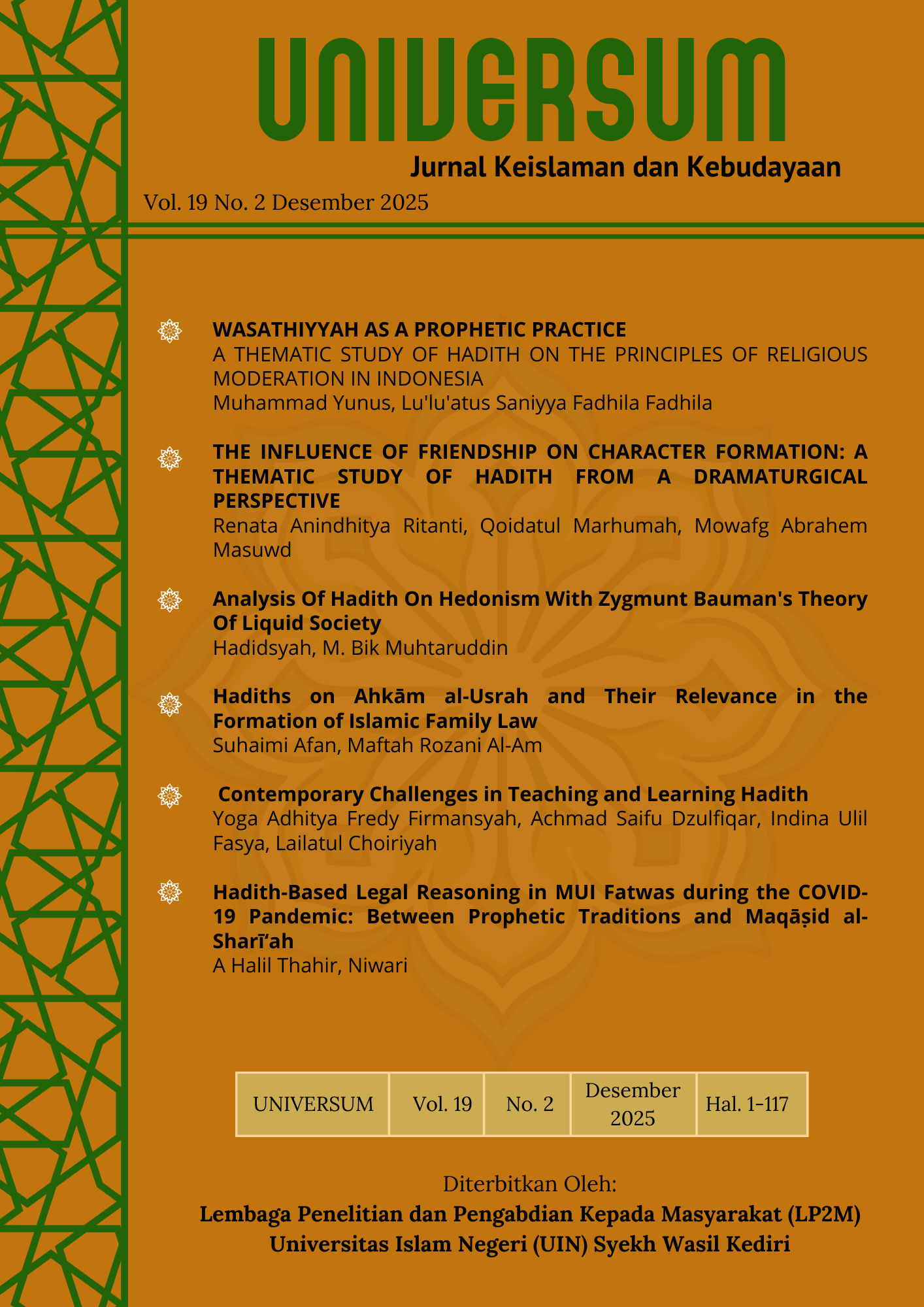
Contemporary Challenges in Teaching and Learning Hadith
DOI:
https://doi.org/10.30762/universum.v19i2.3634Keywords:
Hadith Education, Learning Strategies, Character Education, Islamic Education, Contemporary EducationAbstract
This study aims to analyse learning strategies derived from the hadiths of the Prophet Muhammad (SAW) and identify the challenges of implementing them in the modern era. Using a qualitative literature review approach through the Systematic Literature Review (SLR) method, this study examines scientific works, classical hadith sources, and contemporary educational studies relevant to hadith-based learning. The results of the study show that the Prophet Muhammad (SAW) employed various pedagogical strategies, including educational lectures, discussions, question-and-answer sessions, and exemplary behavior, which were effective in enhancing students' understanding, participation, and character development. These strategies align with modern educational principles that emphasize student-centered learning, dialogic interaction, contextual understanding, and humanistic values. However, the implementation of hadith-based learning strategies in the contemporary era still faces a number of challenges, including low hadith literacy, the dominance of textual and teacher-centred approaches, limited pedagogical competence among educators, and the proliferation of unverified religious information in digital media. Nevertheless, the integration of hadith-based learning strategies with contemporary pedagogical approaches has significant potential to enhance the relevance, effectiveness, and meaningfulness of hadith education. Therefore, hadiths serve not only as a normative religious source but also as a strategic foundation in the development of modern Islamic education.
Downloads
References
Al-Zarnuji, A. (2021). The Importance of Effective Communication in Modern Education. Journal of Islamic Education, 13(2), 45–60.
Aprilia, T. H. (2025). Human Resource Management in Improving the Quality of Education at State Primary School | Allimna: Jurnal Pendidikan Profesi Guru. https://jurnalfaktarbiyah.iainkediri.ac.id/index.php/allimna/article/view/5312
Aprilia, T. H., Masrof, A. H., & Humaidi, A. (2022). Pesantren In Social Construction Perspective (The Educational Orientation Of The Sidogiri Pesantren). TARLIM : JURNAL PENDIDIKAN AGAMA ISLAM, 5(2), 139–157. (discourse analysis). https://doi.org/10.32528/tarlim.v5i2.7903
Aprilia, T. H., & Munifah, M. (2022). Manifestation Of Prophetic Leadership Values In Islamic Education. Tadbir : Jurnal Studi Manajemen Pendidikan, 6(2), 273–285. https://doi.org/10.29240/jsmp.v6i2.4896
Aprilia, T. H., & Sufirmansyah, S. (2025). Santri and the Digital Divide: (The Upheaval of Pesantren Over Technological Developments in Cultural Lag Perspective). Briliant: Jurnal Riset Dan Konseptual, 10(3), 581–592. https://doi.org/10.28926/briliant.v10i3.2215
Aprillia, T. H., Masrof, A. H., Ahid, N., & Huda, S. (2023). Pesantren and Tradition (Study Of Ta’dzim Affiliates in Character Education Al-Ghazali and Thomas Lickona). Edukasi Islami: Jurnal Pendidikan Islam, 12(01). https://doi.org/10.30868/ei.v12i01.2738
Arfani, A. A. D.; Iskarim, M. (2023). Pendekatan Humanis Nabi Muhammad SAW dalam Pendidikan Islam Kontemporer. Tadibia: Journal of Islamic Education, 3(1), 1–15.
Arfani, A. A. D.; Iskarim, M. (2024). Metode Dialog Nabi Muhammad SAW dan Relevansinya terhadap Student-Centered Learning. OASIS: Jurnal Ilmiah Kajian Islam, 9(2), 134–148.
Berger, P. L. (1990). The Sacred Canopy: Elements of a Sociological Theory of Religion. Knopf Doubleday Publishing Group.
Fajar, M. (2021). The Prophet’s Teaching Methods: Relevance to Modern Educational Practices. Islamic Pedagogy Journal, 7(3), 78–89.
Haris, A. (2014). STUDI HADIS KONTEMPORER : Sebuah Upaya Pemetaan Wilayah Kajian Hadis Nabi. Iain Mataram, 1–87.
Hariyanto, W. (2024). Analisis Analisis Metode Pembelajaran dalam Hadist: Implementasi dan Relevansinya dalam Pendidikan Modern. Jurnal Staika: Jurnal Penelitian Dan Pendidikan, 7(2), 136. https://doi.org/10.62750/staika.v7i2.116
Iryanti, S. S.; Affandi, H. A. (2025). Keteladanan Rasulullah SAW sebagai Model Pendidikan Karakter dalam Perspektif Pendidikan Modern. Al-Mu’addib: Jurnal Pendidikan Islam, 7(1), 45–58.
Iryanti, S. S.; Affandi, H. A. (2025). Model Pembelajaran Rasulullah Berbasis Al-Qur’an dan Hadis dalam Konteks Experiential Learning. El-Banat: Jurnal Pemikiran Dan Pendidikan Islam, 15(1), 89–104.
Karim, A. (2019). Pergulatan Hadis di Era Modern. Riwayah : Jurnal Studi Hadis, 3(2), 171. https://doi.org/10.21043/riwayah.v3i2.3720
Khairani, A., & Jannah, L. (2025). Exploring the Lived Experiences of Muslim Micro-Entrepreneurs in Integrating Sharia Values into Business Practices: An Interpretative Phenomenological Analysis (IPA) in Central Java. Journal of Business, Management, and Accounting, 1(10), 451–462.
Maslani, Hoerotunnisa, & Siti Wifa Uswatunnsolihah. (2025). Implementasi Hadist Dalam Metode Pendidikan Modern. AL-MUADDIB: Jurnal Kajian Ilmu Kependidikan, 7(2), 480–490. https://doi.org/10.46773/muaddib.v7i2.1743
Mifta, N. (2023). Character Building Through Exemplary Teaching: Lessons from the Prophet Muhammad. International Journal of Islamic Studies, 15(1), 22–35.
Muasmara, R., Husti, I., Zamsiswaya, Z., & Fibriyani, N. (2025). Learning methods according to hadith: Interactive perspectives in education. ATTARBIYAH: Journal of Islamic Culture and Education, 10(1), 51–67. https://doi.org/10.18326/attarbiyah.v10i1.51-67
Munifah, Aprilia, T. H., & Hamida, U. D. (2025). Asset Management Information Systemin Private Islamic College Environment. Al-Hayat: Journal of Islamic Education, 9(1), 159–180. https://doi.org/10.35723/ajie.v9i1.38
Mutmainah. (2020). Guru Profesional dalam Perspektif Tafsir Hadist. Al-Thiqah : Jurnal Ilmu Keislaman, 3(01), 1–16.
Nasution, Z. (2020). Strategi Pembelajaran Quran Hadis dalam Memaksimalkan Proses Pembelajaran Alquran Hadis. Al-Fatih Jurnal Pendidikan Dan Keislaman, III(2), 269–280. https://doi.org/10.30821/ALFATIH.V3I2.101
Ningrum, D. M., Aprilia, T. H., & Maduarawee, M. (2025). PAI Teacher’s Strategy in Improving Student Achievement at MAN PK MAN 4 Jombang. International Journal of Religion and Social Community, 3(1), 55–68. https://doi.org/10.30762/ijoresco.v3i1.3589
PaSyamsul Rijal Hamidrdosi, F. (2012). Buku Pintar Hadits. WARAQAT : Jurnal Ilmu-Ilmu Keislaman, I(1), 106.
Putri, Y. A., Alfaridzi, M., Mardianto, M., & Anas, N. (2023). Strategi Pembelajaran Al-Hadis dan Media Pembelajaran. EDU SOCIETY: JURNAL PENDIDIKAN, ILMU SOSIAL DAN PENGABDIAN KEPADA MASYARAKAT, 1(2), 213–227. https://doi.org/10.56832/edu.v1i2.62
Rahman, A. (2022). Collaborative Learning in Islamic Education: Insights from Prophetic Traditions. Educational Research and Reviews, 17(5), 99–110.
Rasheed, A. (2024). Educational Strategies of the Prophet Muhammad (PBUH) in the Light of Modern Learning Theories. Journal of Applied Linguistics and TESOL (JALT), 4(2), 115–128.
Rosyad, S., & Alif, M. (2023). Hadis di Era Digital: Tantangan dan Peluang Penggunaan Teknologi dalam Studi Hadis. Jurnal Ilmu Agama: Mengkaji Doktrin, Pemikiran, Dan Fenomena Agama, 24(2), 185–197. https://doi.org/10.19109/jia.v24i2.18979
Rubini, R. (2019). METODE PEMBELAJARAN BERBASIS HADIS. HUMANIKA, 18(1), 31–49. https://doi.org/10.21831/hum.v18i1.23127
Shadra, Y. M., Saddriana, S., & Tajuddin, M. S. (2025). LIVING HADITH AND LOCAL WISDOM: A PHENOMENOLOGICAL STUDY OF THE ANNYORONG LOPI TRADITION IN SOUTHEAST ASIA. Harmoni, 24(1), 106–127. https://doi.org/10.32488/harmoni.v24i1.854
Subakir, A., Mujab, S., & Aprilia, T. H. (2024). LIVING HADIS DALAM DAKWAH KULTURAL KYAI AGENG MUHAMMAD BESARI: RELASI SANTRI–PRIYAYI DI TEGALSARI–PONOROGO (1742–1773 M). UNIVERSUM: Jurnal Keislaman Dan Kebudayaan, 18(2). https://jurnalfuda.iainkediri.ac.id/index.php/universum/article/view/3659
Syaifudin, M., & Sholihah, I. (2025). Living Hadith as an Interdisciplinary Approach: Integration between Textual Studies, Anthropology, and Sociology of Religion. SAMAWAT: Journal Of Hadith and Qur’anic Studies, 9(1), 10–17.
Yumawan, R. L., & Anwar, C. (2022). Profesionalisme Guru Menurut Persfektif Al Quran Dan Al Hadist. Basha’Ir: Jurnal Studi Al-Qur’an Dan Tafsir, 2(June), 29–37. https://doi.org/10.47498/bashair.v2i1.937
Yusuf, H., & Karim, R. (2022). Interactive Teaching Techniques in Modern Classrooms: A Prophetic Approach. Journal of Contemporary Education, 9(4), 65–78.
Downloads
Published
How to Cite
Issue
Section
License
Copyright (c) 2025 Yoga Adhitya Fredy Firmansyah, Achmad Saifu Dzulfiqar, Indina Ulil Fasya, Lailatul Choiriyah

This work is licensed under a Creative Commons Attribution 4.0 International License.