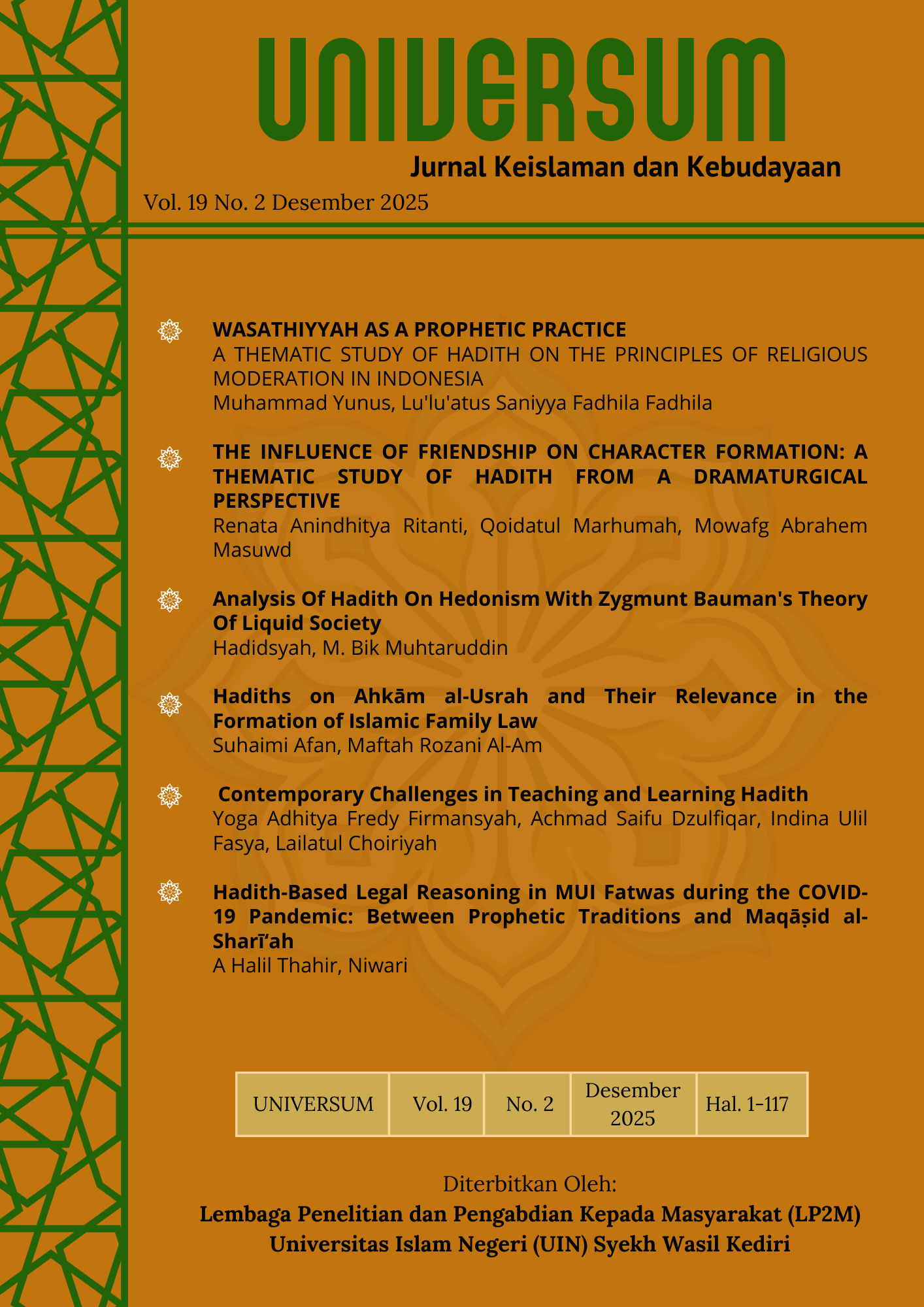
Hadiths on Ahkām al-Usrah and Their Relevance in the Formation of Islamic Family Law
DOI:
https://doi.org/10.30762/universum.v19i2.3582Keywords:
Hadiths, Ahkām al-Usrah, Islamic Family Law, Ma‘ānī al-Ḥadīs, Maqāṣid al-Syarī‘ahAbstract
Islamic family law is the area of law that is closest to the lives of the people and continues to undergo dynamics in line with social changes. The hadiths of ahkām al-usrah, as the second normative source after the Qur'an, play a strategic role in the formation of Islamic family law, but are often understood textually and ahistorically. This study aims to analyse the typology of family law hadiths, explore the substantive meaning of hadiths through the ma‘ānī al-ḥadīs approach, and assess their relevance in the formation of contemporary Islamic family law. This study uses a qualitative method with a literature review approach, analysing family hadiths in authoritative hadith books as well as contemporary Islamic jurisprudence and thought literature. The results show that ahkām al-usrah hadiths have diverse normative functions oriented towards ethical values such as justice, responsibility, and family protection. Through the integration of the ma‘ānī al-ḥadīs and maqāṣid al-syarī‘ah approaches, these hadiths are proven to be relevant and adaptive in responding to the challenges of modern Islamic family law. This study emphasises the importance of contextual reading of hadith as the basis for the formation of Islamic family law that is just and oriented towards public interest.
Downloads
References
Al-‘Asqalānī, I. Ḥajar. (n.d.). Fatḥ al-Bārī bi Sharḥ Ṣaḥīḥ al-Bukhārī. Beirut: Dār al-Ma‘rifah.
Al-Bukhārī. (n.d.-a). Ṣaḥīḥ al-Bukhārī, Kitāb al-Aḥkām, no. 7138.
Al-Bukhārī. (n.d.-b). Ṣaḥīḥ al-Bukhārī, Kitāb al-Nikāḥ, no. 5066.
Al-Bukhārī, M. ibn I. (2001). Ṣaḥīḥ al-Bukhārī. Beirut: Dār Ṭawq al-Najāh.
Al-Ghazālī, M. (1989). Al-Sunnah al-Nabawiyyah bayna Ahl al-Fiqh wa Ahl al-Ḥadīth. Kairo: Dār al-Shurūq.
Al-Idlibī, Ṣalāḥ al-Dīn. (1983). Manhaj Naqd al-Matn ‘inda ‘Ulamā’ al-Ḥadīs. Beirut: Dār al-Afāq al-Jadīdah.
Al-Khaṭīb, M. ‘Ajjāj. (2003). Uṣūl al-Ḥadīs: ‘Ulūmuhu wa Muṣṭalaḥuhu. Beirut: Dār al-Fikr.
Al-Nawawī. (n.d.). Sharḥ Ṣaḥīḥ Muslim. Beirut: Dār Iḥyā’ al-Turāth al-‘Arabī.
Al-Qaraḍāwī, Y. (1990). Kayfa Nata‘āmal ma‘a al-Sunnah al-Nabawiyyah. Kairo: Dār al-Shurūq.
Al-Qaradawi, Y. (2006). Dirāsah fī Fiqh Maqāṣid al-Sharī‘ah. Kairo: Dār al-Shurūq.
Al-Shāfi‘ī. (2004). Al-Risālah, ed. Aḥmad Muḥammad Shākir. Kairo: Dār al-Ḥadīth.
Al-Tirmidhī. (n.d.). Sunan al-Tirmidhī, no. 1159.
Al-Zuhaylī, W. (1989). Al-Fiqh al-Islāmī wa Adillatuhu. Damaskus: Dār al-Fikr.
An-Na‘im, A. A. (2008). Islam and the Secular State. Cambridge: Harvard University Press.
Aprilia, T. H. (2025). Human Resource Management in Improving the Quality of Education at State Primary School | Allimna: Jurnal Pendidikan Profesi Guru. https://jurnalfaktarbiyah.iainkediri.ac.id/index.php/allimna/article/view/5312
Aprilia, T. H., Masrof, A. H., & Humaidi, A. (2022). Pesantren In Social Construction Perspective (The Educational Orientation Of The Sidogiri Pesantren). TARLIM : JURNAL PENDIDIKAN AGAMA ISLAM, 5(2), 139–157. (discourse analysis). https://doi.org/10.32528/tarlim.v5i2.7903
Aprilia, T. H., & Munifah, M. (2022). Manifestation Of Prophetic Leadership Values In Islamic Education. Tadbir : Jurnal Studi Manajemen Pendidikan, 6(2), 273–285. https://doi.org/10.29240/jsmp.v6i2.4896
Aprilia, T. H., & Sufirmansyah, S. (2025). Santri and the Digital Divide: (The Upheaval of Pesantren Over Technological Developments in Cultural Lag Perspective). Briliant: Jurnal Riset Dan Konseptual, 10(3), 581–592. https://doi.org/10.28926/briliant.v10i3.2215
Aprillia, T. H., Masrof, A. H., Ahid, N., & Huda, S. (2023). Pesantren and Tradition (Study Of Ta’dzim Affiliates in Character Education Al-Ghazali and Thomas Lickona). Edukasi Islami: Jurnal Pendidikan Islam, 12(01). https://doi.org/10.30868/ei.v12i01.2738
Auda, J. (2008). Maqasid al-Shariah as Philosophy of Islamic Law. London: IIIT.
Ayyubi, M. S. A., & Aprilia, T. H. (2023). Hukuman Mati Bagi Murtad Perspektif Syekh Ali Jum’ah. Syariah: Journal of Fiqh Studies, 1(1), 43–60. https://doi.org/10.61570/syariah.v1i1.17
Azizah, N. (2014). HADÎTS-HADÎTS TENTANG KEUTAMAAN NIKAH DALAM KITAB LUBÂB AL-HADÎTS KARYA JALÂL AL-DÎN AL-SUYÛTHÎ. Dialogia, 12(1). https://doi.org/10.21154/dialogia.v12i1.304
B. Hallaq, W. (2009). An Introduction to Islamic Law. Cambridge: Cambridge University Press.
Baiquni, A. (2024). Kritik Khaled Abou El Fadl terhadap Penggunaan Hadis Perempuan Sumber Fitnah di Kalangan Islam Puritan. MISYKAT: Jurnal Ilmu-Ilmu Al-Quran Hadits Syari’ah Dan Tarbiyah, 9(2), 113–123. https://doi.org/10.33511/misykat.v9n2.113-123
Dāwud, A. (n.d.). Sunan Abī Dāwud, Kitāb al-Nikāḥ, no. 2140.
Devi, C. P., & Aminuddin, A. (2025). Maqāṣid Al-Syarī‘Ah Sebagai Basis Perlindungan Perempuan Dari Kekerasan. SANGAJI: Jurnal Pemikiran Syariah Dan Hukum, 9(2), 185–195. https://doi.org/10.52266/sangaji.v9i2.5357
Fadl, K. A. E. (2001). Speaking in God’s Name: Islamic Law, Authority and Women. Oxford: Oneworld.
Fatimawali, F., Abidin, Z., & Jumat, G. (2024). Teori Maqashid Al-Syari’ah Modern: Perspektif Jasser Auda. Prosiding Kajian Islam Dan Integrasi Ilmu Di Era Society (KIIIES) 5.0, 3(1), 232–237.
Hasbi, R. (2011). Elastisitas Hukum Nikah dalam Perspektif Hadits. Jurnal Ushuluddin, 17(1), 23–37. https://doi.org/10.24014/jush.v17i1.680
Kamal, M. (2023). Hukum Keluarga Islam dalam Menata Relasi Suami Istri di Era Teknologi. Ameena Journal, 1(1), 130–139.
Moleong, L. J. (2019). Metodologi Penelitian Kualitatif. Bandung: Remaja Rosdakarya.
Munifah, Aprilia, T. H., & Hamida, U. D. (2025). Asset Management Information Systemin Private Islamic College Environment. Al-Hayat: Journal of Islamic Education, 9(1), 159–180. https://doi.org/10.35723/ajie.v9i1.38
Muslim. (n.d.-a). Ṣaḥīḥ Muslim, Kitāb al-Imārah, no. 1829.
Muslim. (n.d.-b). Ṣaḥīḥ Muslim, Kitāb al-Nikāḥ, no. 1400.
Ningrum, D. M., Aprilia, T. H., & Maduarawee, M. (2025). PAI Teacher’s Strategy in Improving Student Achievement at MAN PK MAN 4 Jombang. International Journal of Religion and Social Community, 3(1), 55–68. https://doi.org/10.30762/ijoresco.v3i1.3589
Nurhadi, N. (2018). Konsep Tanggung Jawab Suami dalam Mendidik Istri Perspektif Hadis Nabi Muhammad SAW Pada Kitab Kutub al-Tis’ah. Jurnal Pendidikan Agama Islam Al-Thariqah, 3(2), 74–83. https://doi.org/10.25299/althariqah.2018.vol3(2).2341
Nursyahbani, I., Nurhamdani, A., Husen, F., & Firdaus, M. A. (2024). Maqāṣid al-Nabawī: Pendekatan Ilmu Maqāṣid al-Syarī’ah Dalam Kajian Hadis. Jurnal Studi Agama, 8(2), 84–102. https://doi.org/10.19109/jsa.v8i2.25240
Putri, A. S., Khayu, A., & Aprilia, T. H. (2024). Nilai-Nilai Islam Dalam Tradisi Tingkeban di Kelurahan Ngampel Kota Kediri. Al-Mabsut : Jurnal Studi Islam dan Sosial, 18(1), 127–136. https://doi.org/10.56997/almabsutjurnalstudiislamdansosial.v18i1.1534
Rahman, F. (1982). Islam and Modernity: Transformation of an Intellectual Tradition. Chicago: University of Chicago Press.
Rifnawati, F., & Epriyani, A. (2025). Pengaruh Maqashid Syariah terhadap Kebahagiaan Muslimah di Indonesia: Studi Kasus Ifls 5 Tahun 2014. Journal of Islamic Economics and Finance, 3(3), 111–125. https://doi.org/10.59841/jureksi.v3i3.2962
Ropei, A. (2021). MAQASHID SYARIâ€TMAH DALAM PENGATURAN BATAS USIA PERNIKAHAN DI INDONESIA. Asy-Syari’ah, 23(1), 1 – 20-1 – 20. https://doi.org/10.15575/as.v23i1.10607
Rusydiana, N. R. U., & Azami, H. T. (2021). Interpretation QS. an-Nisa’: 34 Perspectives of Amina Wadud Muhsin and The Implication of Her Thinking In Indonesia. Jurnal Ushuluddin, 29(1), 87–100. https://doi.org/10.24014/jush.v29i1.11931
Samsukadi, M. (2021). Metodologi Studi Hadis Ahkam Imam Al-Shafi’i. 6(2), 163–179.
Subakir, A., Mujab, S., & Aprilia, T. H. (2024). LIVING HADIS DALAM DAKWAH KULTURAL KYAI AGENG MUHAMMAD BESARI: RELASI SANTRI–PRIYAYI DI TEGALSARI–PONOROGO (1742–1773 M). UNIVERSUM: Jurnal Keislaman Dan Kebudayaan, 18(2). https://jurnalfuda.iainkediri.ac.id/index.php/universum/article/view/3659
Sulthon, A. (2023). STUDI TENTANG HAK DAN KEWAJIBAN SUAMI DALAM PERSPEKTIF HADIST AHKAM DAN HUKUM POSITIF. Jurnal Hukum Keluarga Islam El-Qisth, 6(02). https://ejournal.uluwiyah.ac.id/index.php/qisth/article/view/101
Surahmat. (2015). POTRET IDEAL RELASI SUAMI ISTRI (Telaah Pemikiran Hadith Shaikh Nawawi Al-Bantani). Universum, 9(01), 89–101. https://doi.org/10.30762/universum.v9i01.769
Ulum, S., & Alif, M. (2025). Studi Hadis Tematik: Pendekatan Klasik dan Kontemporer. IHSANIKA : Jurnal Pendidikan Agama Islam, 3(3), 324–337. https://doi.org/10.59841/ihsanika.v3i3.2975
Wadud, A. (1999). Qur’an and Woman: Rereading the Sacred Text from a Woman’s Perspective. New York: Oxford University Press.
Warman, A. B. (2019). Dinamika Perkembangan Hukum Keluarga Islam di Indonesia. IJTIHAD, 35(2). https://journals.fasya.uinib.org/index.php/ijtihad/article/view/14
Zahrah, M. A. (1958). Uṣūl al-Fiqh. Kairo: Dār al-Fikr al-‘Arabī.
Zed, M. (2008). Metode Penelitian Kepustakaan. Jakarta: Yayasan Obor Indonesia.
Downloads
Published
How to Cite
Issue
Section
License
Copyright (c) 2025 Suhaimi Afan, Maftah Rozani Al-Am

This work is licensed under a Creative Commons Attribution 4.0 International License.