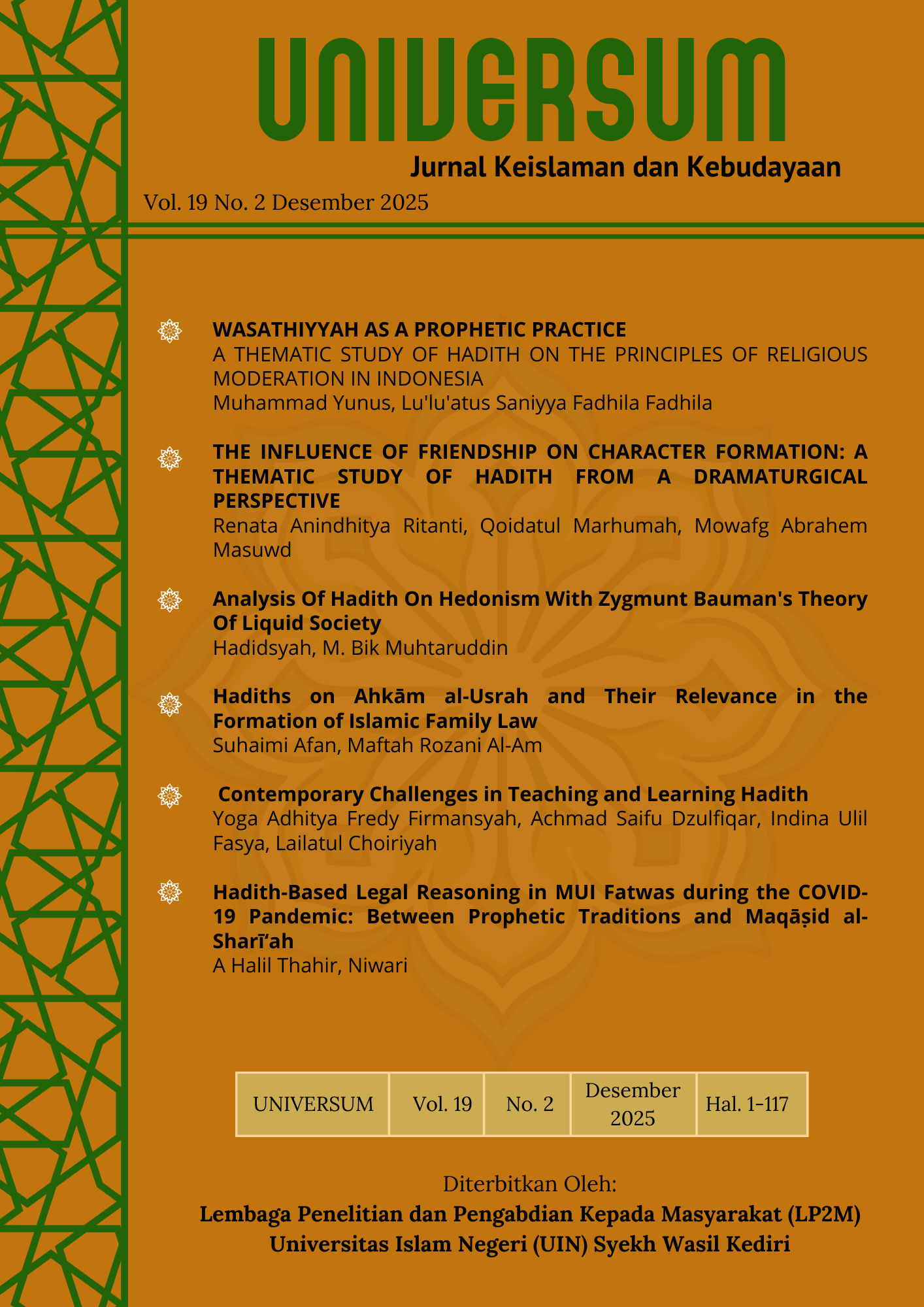
Hadith-Based Legal Reasoning in MUI Fatwas during the COVID-19 Pandemic: Between Prophetic Traditions and Maqāṣid al-Sharī‘ah
Keywords:
Istidlāl Hadith, Fatwa MUI, Maqāṣid al-Sharī‘ahAbstract
This research examines the fiqh of priorities in the fatwas of the Indonesian Ulama Council during the COVID-19 pandemic. The problem presented in it is : What are the areas of the fatwas of the Indonesian Ulama Council during the COVID-19 pandemic? How does the Indonesian Ulama Council issue a fatwa during the COVID-19 pandemic from the perspective of the fiqh of priorities?
This research is desk research. Its data is available from library sources, both major and bilateral. The method of collecting data is documentary, which means collecting it in writing. The method of analyzing it is the content analysis that the researcher uses in analyzing the fiqh of priorities in the fatwas of the Indonesian Ulama Council during the COVID-19 pandemic.
During the COVID-19 pandemic, various religious practices and rituals have been restricted or even postponed, preventing the spread of the virus. In this context, the Indonesian Ulema Council (MUI) issued a number of fatwas, including an important fatwa on 16 March 2020, shortly after the first case of COVID-19 was announced in Indonesia. This study aims to examine the hadith-based legal reasoning in the MUI's fatwas during the COVID-19 pandemic by highlighting the relationship between hadith arguments and the maqāṣid al-sharī‘ah framework through the fiqh al-awlawiyyāt (fiqh of priorities) approach. This study is a literature review using primary and secondary sources. Data was collected through documentation and analysed using content analysis to identify patterns of use, interpretation, and prioritisation of hadiths in MUI fatwas. The results of the study show that MUI fatwas during the pandemic cover three main areas, namely worship, individual, and socio-religious. MUI's legal reasoning shows consistency in prioritising hadiths oriented towards the protection of life (ḥifẓ al-nafs), prevention of harm, and public interest. These hadiths are operationalised contextually through the principle of maqāṣid al-sharī‘ah, resulting in fatwas that are responsive to health emergencies without negating the normative authority of hadith.
Keywords: Fatwa of the Indonesian Ulama Council, COVID-19, fiqh of priorities, the Quran, Hadits
Downloads
References
Abitolkha, A. M., Thahir, A. H., Muzakki, A., & Dodi, L. (2025). The Convergence of Sufism and Sharia: The Spiritual Basis of Family Resilience in Shiddiqiyah Congregation in Jombang, Indonesia. El-Usrah: Jurnal Hukum Keluarga, 8(2), 678–700. https://doi.org/10.22373/dvp86k16
Afan, S., & Al-Am, M. R. (2025). Hadiths on Ahkām al-Usrah and Their Relevance in the Formation of Islamic Family Law. Universum, 19(2), 56–74. https://doi.org/10.30762/universum.v19i2.3582
Ahmad, S., Long, A. S., Rahman, Z. A., Taufiq, M., & Elmhemit, H. (2024). Mafhūmu Fiqhi al-Marātib wa Fiqhi al-Awlawiyyāt fī Maqāṣidi al-Qurʾān: Dirāsah Taṭbīqiyyah fī Malaysia. AL-IHKAM: Jurnal Hukum & Pranata Sosial, 19(1), 271–302. https://doi.org/10.19105/al-lhkam.v19i1.8917
al-‘Asqalānī, I. Ḥajar. (n.d.). Fatḥ al-Bārī bi Sharḥ Ṣaḥīḥ al-Bukhārī. Beirut: Dār al-Ma‘rifah.
Al-Bukhārī. (n.d.). Kitāb al-Aḍḥiyah, Hadis no. 69.
Al-Bukhārī, Ṣaḥīḥ. (n.d.). Kitāb al-Ṭibb, Hadis no. 5678.
Al-Muwaṭṭa’, M. (n.d.). Hadis no. 184.
Al-Nawawi. (n.d.). Sharḥ Ṣaḥīḥ Muslim. Beirut: Dār Ihyā’ al-Turāth al-‘Arabī.
Al-Qaradawi, Y. (1995). Fiqh al-Awlawiyyāt: Dirāsah Jadīdah fī Ḍaw’ al-Qur’ān wa al-Sunnah. Kairo: Dār al-Shurūq.
Al-Shatibi. (2001). Al-Muwafaqat fi Usul al-Shari‘ah. Beirut: Dar al-Kutub al-‘Ilmiyyah.
Andaluzi, F., & Prameswari, D. G. (2025). THE AUTHORITY OF HADITH IN CONTEMPORARY DISCOURSE: REREADING THE VIEWS OF ORIENTALISTS, OCCIDENTALISTS, AND MODERN SCHOLARS. Universum, 19(1), 105–128. https://doi.org/10.30762/universum.v19i1.3353
Anisa, A. (2021). Comparative Study of the Ijtihad Method of the Indonesian Ulema Council and Bahtsul Masail Nahdlatul Ulama on the Fatwa of the Astrazeneca Vaccine. Ulumuddin Journal of Islamic Legal Studies, 2(1), 1–20.
Ansori, I. H. (2018). Akal dan Agama Perempuan (Perspektif Hadis Nabi dan Psikologi). Universum, 12(1), 9–20. https://doi.org/10.30762/universum.v12i1.1108
Ansori, I. H., & Fadhila, L. S. (2025). Interpretasi Hadis tentang Memuliakan Wanita dan Implikasinya dalam Membangun Keluarga Harmonis Perspektif Husein Muhammad. JADID: Journal of Quranic Studies and Islamic Communication, 5(01), 21–38. https://doi.org/10.33754/jadid.v5i01.1291
Ansori, I. H., Rahman, R., & Darussamin, Z. (2020). A Genealogy of ‘Ilal Al-Hadîth Study (Tracing the Historical Root Gene of Existence and Development The Study of ‘Ilal Al-Hadith). Jurnal Ushuluddin, 28(1), 1–14. https://doi.org/10.24014/jush.v28i1.9215
Anzar, N. A., & Syaripudin, A. (2024). Hukum Tes Swab saat Berpuasa untuk Deteksi Covid-19 pada Bulan Ramadan (Studi Fatwa MUI No. 23 tahun 2021): Law for Swab Tests while Fasting for Detection of Covid-19 in the Month of Ramadan (Study of MUI Fatwa Number 23 of 2021). AL-QIBLAH: Jurnal Studi Islam Dan Bahasa Arab, 3(1), 1–20. https://doi.org/10.36701/qiblah.v3i1.1300
Aprilia, T. H., Masrof, A. H., & Humaidi, A. (2022). Pesantren In Social Construction Perspective (The Educational Orientation Of The Sidogiri Pesantren). TARLIM : JURNAL PENDIDIKAN AGAMA ISLAM, 5(2), 139–157. (discourse analysis). https://doi.org/10.32528/tarlim.v5i2.7903
Aprilia, T. H., & Munifah, M. (2022a). Manifestation Of Prophetic Leadership Values In Islamic Education. Tadbir : Jurnal Studi Manajemen Pendidikan, 6(2), 273–285. https://doi.org/10.29240/jsmp.v6i2.4896
Aprilia, T. H., & Munifah, M. (2022b). Manifestation Of Prophetic Leadership Values In Islamic Education. Tadbir : Jurnal Studi Manajemen Pendidikan, 6(2), 273–285. https://doi.org/10.29240/jsmp.v6i2.4896
Aprilia, T. H., & Sufirmansyah, S. (2025). Santri and the Digital Divide: (The Upheaval of Pesantren Over Technological Developments in Cultural Lag Perspective). Briliant: Jurnal Riset Dan Konseptual, 10(3), 581–592. https://doi.org/10.28926/briliant.v10i3.2215
Aprillia, T. H., Masrof, A. H., Ahid, N., & Huda, S. (2023). Pesantren and Tradition (Study Of Ta’dzim Affiliates in Character Education Al-Ghazali and Thomas Lickona). Edukasi Islami: Jurnal Pendidikan Islam, 12(01). https://doi.org/10.30868/ei.v12i01.2738
‘Ashur, M. al-Tahir ibn. (1990). Maṣādir al-Sharī‘ah wa al-Maqāṣid. Tunis: al-Dār al-Tūnisiyyah.
Aslati, A., & Afrizal, A. (2018). AL-QAWA’ID AL-MAQASHIDIAH YANG TERKAIT DENGAN MASHLAHAT DAN MAFSADAT (Studi Pemikiran Abd al-Rahman Ibrahim al-Kailani). An-Nida’, 41(1), 16–30. https://doi.org/10.24014/an-nida.v41i1.4634
Auda, J. (2008). Maqasid al-Shariah as Philosophy of Islamic Law. London: IIIT.
Ayyubi, M. S. A., & Aprilia, T. H. (2023). Hukuman Mati Bagi Murtad Perspektif Syekh Ali Jum’ah. Syariah: Journal of Fiqh Studies, 1(1), 43–60. https://doi.org/10.61570/syariah.v1i1.17
Brown, J. A. C. (2009). Hadith: Muhammad’s Legacy in the Medieval and Modern World. Oxford: Oneworld.
Budiyanto, B., & Akbar, D. L. (2020). Konsep Kesehatan Dalam Al-Qur’an Dan Hadis. Al-Bayan: Jurnal Ilmu al-Qur’an Dan Hadist, 3(2), 157–173. https://doi.org/10.35132/albayan.v4i2.90
Chanifah, N., Rohmah, S., Kholish, M. A., Syaikhoni, S., Samsudin, A., & Ansori, I. H. (2025). INVESTIGATION LEGALITY AND CERTIFICATION PROCESS OF HALAL PRODUCT GUARANTEE: South Korea Muslim Federation as a Muslim Minority Country. Al-Risalah: Forum Kajian Hukum Dan Sosial Kemasyarakatan, 25(2), 1–19. https://doi.org/10.30631/alrisalah.v25i2.1620
Dāwūd, A. (n.d.). Kitāb al-Ṭibb, Hadis no. 3875.
Hafidzi, A. (2020). Kewajiban Penggunaan Vaksin: Antara Legalitas dan Formalitas dalam Pandangan Maqashid Al-Syariah. YUDISIA : Jurnal Pemikiran Hukum Dan Hukum Islam, 11(2), 209–218. https://doi.org/10.21043/yudisia.v11i2.4076
Hakim, A., & Bustomi, Y. I. (2021). ANALISIS ISTINBATH AHKAM FATWA MAJELIS ULAMA INDONESIA NOMOR 14 TAHUN 2021 TENTANG HUKUM PENGGUNAAN VAKSIN COVID-19 PRODUK ASTRAZENECA. Muẚṣarah: Jurnal Kajian Islam Kontemporer, 3(2), 9–14. https://doi.org/10.18592/msr.v3i2.5704
Hakim, A., Sholihah, F. M., & Anifa, N. A. (2023). Konsep Ikhtiar dalam Berobat sesuai Ajaran Islam. Religion : Jurnal Agama, Sosial, Dan Budaya, 2(4), 914–924. https://doi.org/10.55606/religion.v1i4.508
Hanbal, A. ibn. (n.d.). Musnad Ahmad, Hadis no. 17492.
Hanik, U., & Ansori, I. H. (2019). The Study of Living Hadith of the Ancak Tradition in Wedoroklurak Village, Candi, Sidoarjo. ESENSIA: Jurnal Ilmu-Ilmu Ushuluddin, 20(2), 217–231. https://doi.org/10.14421/esensia.v20i2.2110
Haqqi, A., Tamimi, A., & Huri, A. D. (2023). HADIS BEROBAT DENGAN BENDA HARAM DALAM SUNAN ABU DAWUD METODE MUKHTALIF Al-HADIS SYAIKH SHALIH AL-USAIMIN. Jurnal Riset Rumpun Agama Dan Filsafat, 2(2), 01–12. https://doi.org/10.55606/jurrafi.v2i2.1476
Hardi, E. A. (2018). KAIDAH AL-MASYAQQAH TAJLIBU AT-TAISIR DALAM EKONOMI ISLAM.docx. Nizham Journal of Islamic Studies, 6(02), 99–110.
Hijrah, N., & Aziz, S. (2023). Pandangan Tokoh Organisasi Keislaman Terhadap Fatwa MUI Tentang Shalat Berjamaan Masa Pandemi Covid-19. Muqaranah, 7(1), 67–74. https://doi.org/10.19109/muqaranah.v7i1.17336
Indonesia, M. U. (2020a). Fatwa MUI Nomor 14 Tahun 2020 tentang Penyelenggaraan Ibadah dalam Situasi Terjadi Wabah COVID-19. Jakarta: MUI.
Indonesia, M. U. (2020b). Himpunan Fatwa Majelis Ulama Indonesia. Jakarta: Sekretariat MUI.
Indonesia, M. U. (2021). Fatwa No. 13 Tahun 2021 tentang Vaksin COVID-19. Jakarta: MUI.
Ishak, S. (2020). Kemudharatan Tidak Dihilangkan Dengan Kemudharatan. Jurnal Al-Mizan, 7(2), 117–126.
Kasim, M., Syarif, M. I., & Mattanra, A. (2024). Penerapan Kaidah Lā Ḍarara wa Lā Ḍirār dalam Penggunaan Mercon untuk Mengusir Hama Tanaman: Application of Lā Ḍarara wa Lā Ḍirār Principle in Using Mercon to Repel Internal Plant Pests. AL-QIBLAH: Jurnal Studi Islam Dan Bahasa Arab, 3(5), 843–865. https://doi.org/10.36701/qiblah.v3i5.1746
Khamim, K., Hijriyati, M., Ansori, I. H., & Fauriz, M. H. (2024). Livelihood Responsibility Shifting to Migrant Worker Wives; A Reading of Qur’an and Hadith in Muslim Community. AL-IHKAM: Jurnal Hukum & Pranata Sosial, 19(2), 574–602. https://doi.org/10.19105/al-lhkam.v19i2.11109
Latief, H. M. A. (2021). DARURAT VAKSIN, FATWA MUI DAN TINJAUAN FIKIH DARURI (STUDI KASUS FATWA VAKSIN COVID-19 DI INDONESIA). istinbath, 20(2), 241–261. https://doi.org/10.20414/ijhi.v20i2.386
Lubis, K. C., Nasution, A. K., & Rahman, A. (2025). Peran Qawaid Fiqiyyah Sebagai Pedoman Etika Dalam Pemanfaatan Sumber Daya Alam di Bidang Pertanian dan Pertambangan. QISTINA: Jurnal Multidisiplin Indonesia, 4(2), 2640–2647. https://doi.org/10.57235/qistina.v4i2.7759
Mahmudin, M. (2021). KRITERIA (RUKHSAH) KEMUDAHAN DALAM SYARIAT. AL-SULTHANIYAH, 10(2), 32–43. https://doi.org/10.37567/al-sulthaniyah.v10i2.1293
Mājah, I. (n.d.). Kitāb al-‘Ilm, Hadis no. 241.
Moleong, L. J. (2017). Metodologi Penelitian Kualitatif. Bandung: Remaja Rosdakarya.
Muhaimin, U. (2018). METODE ISTIDLAL DAN ISTISHAB (FORMULASI METODOLOGI IJTIHAD). YUDISIA : Jurnal Pemikiran Hukum Dan Hukum Islam, 8(2), 330–350. https://doi.org/10.21043/yudisia.v8i2.3243
Mun’im, Z. (2022). The Epistemology of MUIâ€TMs Fatwas on Covid-19: Bayani and Burhani Eclecticism. Al-Istinbath: Jurnal Hukum Islam, 7(1 May), 1–20. https://doi.org/10.29240/jhi.v7i1.3216
Murdani. (2021). Kondisi Dharurat Membolehkan Hal-hal yang Diharamkan. Jurnal Al-Mizan, 8(1), 100–117. https://doi.org/10.54621/jiam.v8i1.120
Muslim. (n.d.). Kitāb al-Ṣalāh, Hadis no. 282.
Mustawa, M., Yuslem, N., & Damanik, N. (2023). Hadis-Hadis Wabah Taun dalam Fatwa Mui Nomor 14 Tahun 2020: (Studi Ma’ani Al-Hadits). Kamaya: Jurnal Ilmu Agama, 6(4), 524–533. https://doi.org/10.37329/kamaya.v6i4.2799
Muttakin, B., & Hadi, A. (2024). Analisis Fatwa Ulama Indonesia dalam Menyikapi Pandemi Corona Virus 2019 | JOSH: Journal of Sharia. https://ejournal.unsuda.ac.id/index.php/josh/article/view/924
Natasya, S. A., Tanjung, F. A., & Rahman, A. (2025). Perspektif Kaidah Al-Masyaqqah Tajlibut-Taysīr terhadap Keabsahan Akad Otomatis pada Transaksi Digital. AHKAM, 4(4), 1795–1805. https://doi.org/10.58578/ahkam.v4i4.8345
Nina, Aisyah, S., & Latifah. (2025). Hukum Mengonsumsi Obat-Obatan yang Mengandung Bahan Baku Non-Halal dalam Islam. JIKES : Jurnal Ilmu Kesehatan, 4(1), 59–64. https://doi.org/10.71456/jik.v4i1.1499
Nurhakim, A. (2020). KONSEP DARURAT DALAM HUKUM KETATANEGARAAN ISLAM. Al-Mashlahah Jurnal Hukum Islam dan Pranata Sosial, 8(01), 236–246. https://doi.org/10.30868/am.v8i1.689
Pratama, C., Jinan, R., & Muharram, T. Z. (2022). Penggunaan Masker ketika Shalat Berjamaah sebagai Upaya Meminimalisir Penyebaran Covid-19 menurut Majelis Ulama Indonesia. Komparatif: Jurnal Perbandingan Hukum Dan Pemikiran Islam, 2(1), 27–54. https://doi.org/10.15642/komparatif.v2i1.1901
Purnama, O. A. Z., Sulistiani, S., Humaeroh, M., & Taqiyuddin, H. (2025). Hadis dan Ushul Fiqh: Studi Tentang Peran Hadis dalam Menentukan Hukum Islam. Hikmah : Jurnal Studi Pendidikan Agama Islam, 2(2), 59-72. https://doi.org/10.61132/hikmah.v2i2.878
Putra, A. R. A. S. (2020). The Contextualization of Islamic Law in the Pandemic Period through Fiqhiyyah Rules in the MUI Fatwa No. 14 of 2020 as an Effort to Re-actualize the Concept of Religious Moderation. KURIOSITAS: Media Komunikasi Sosial dan Keagamaan, 13(2), 141–166. https://doi.org/10.35905/kur.v13i2.1415
Putra, P. A. A. (2023). Aplikasi Kaidah Lâ Dharara Wa Lâ Dhirâr Dalam Hukum Ekonomi Syariah. Al-Kharaj : Jurnal Ekonomi, Keuangan & Bisnis Syariah, 6(2), 2164–2179. https://doi.org/10.47467/alkharaj.v6i2.4391
Rosidah, A., Thahir, A. H., & Hakim, M. H. A. (2025). Paradigma Ijtihad Maqashidi dalam Pemikiran Ahmad ar-Raisuni. CARONG: Jurnal Pendidikan, Sosial Dan Humaniora, 2(2), 927–939. https://doi.org/10.62710/vvakmy76
Saifuddin, S., Hasanah, H., Akhyar, A., Muzana, S. R., Syakinah, A. U., & Astuti, M. (2022). New Normal in the Sunnah of the Prophet. AL-ISHLAH: Jurnal Pendidikan, 14(3), 4395–4404. https://doi.org/10.35445/alishlah.v14i3.1419
Subakir, A., Mujab, S., & Aprilia, T. H. (2024). LIVING HADIS DALAM DAKWAH KULTURAL KYAI AGENG MUHAMMAD BESARI: RELASI SANTRI–PRIYAYI DI TEGALSARI–PONOROGO (1742–1773 M). UNIVERSUM: Jurnal Keislaman Dan Kebudayaan, 18(2). https://jurnalfuda.iainkediri.ac.id/index.php/universum/article/view/3659
Suhaimi, S., Rezi, M., & Hakim, M. R. (2023). AL-MAQÂSHID AL-SYARÎ’AH: Sahaja: Journal Sharia and Humanities, 2(1), 153–170. https://doi.org/10.61159/sahaja.v2i1.13
Thahir, A. H. (2024). Towards the Multidimensional Ushul Al-Fiqh: A Study of the Integration of Science in the Fatwa of Majelis Ulama Indonesia. Samarah: Jurnal Hukum Keluarga Dan Hukum Islam, 8(2), 687–705. https://doi.org/10.22373/sjhk.v8i2.19686
Wafi, A., Muzainah, G., Maghfirah, S., & Hikmah, N. (2025). BABILANGAN: THE TRADITION OF BANJARESE PEOPLE BEFORE MARRIAGE IN FIQH MUWAZANAH PERSPECTIVE. JOURNAL OF ISLAMIC AND LAW STUDIES, 9(3), 239–251. https://doi.org/10.18592/jils.v9i3.17728
WHO. (2020). Coronavirus Disease (COVID-19) Pandemic. laporan situasional WHO.
Zen, H. (2024). KAJIAN ISTINBĀTH MAQĀSHID AL-SYARĪ’AH DALAM BIDANG EKONOMI. Jurnal Media Akademik (JMA), 2(12). https://doi.org/10.62281/v2i12.1425
Zulyenni, Y. (2023). Analisis Fatwa MUI Tentang Tes Swab Untuk Mendeteksi Covid-19 Saat Berpuasa Perspektif Pandangan Ulama dan Relevansinya. Palita: Journal of Social Religion Research, 8(1), 49–78. https://doi.org/10.24256/pal.v8i1.3623
Downloads
Published
How to Cite
Issue
Section
License
Copyright (c) 2025 Halil, Niwari Niwari

This work is licensed under a Creative Commons Attribution 4.0 International License.