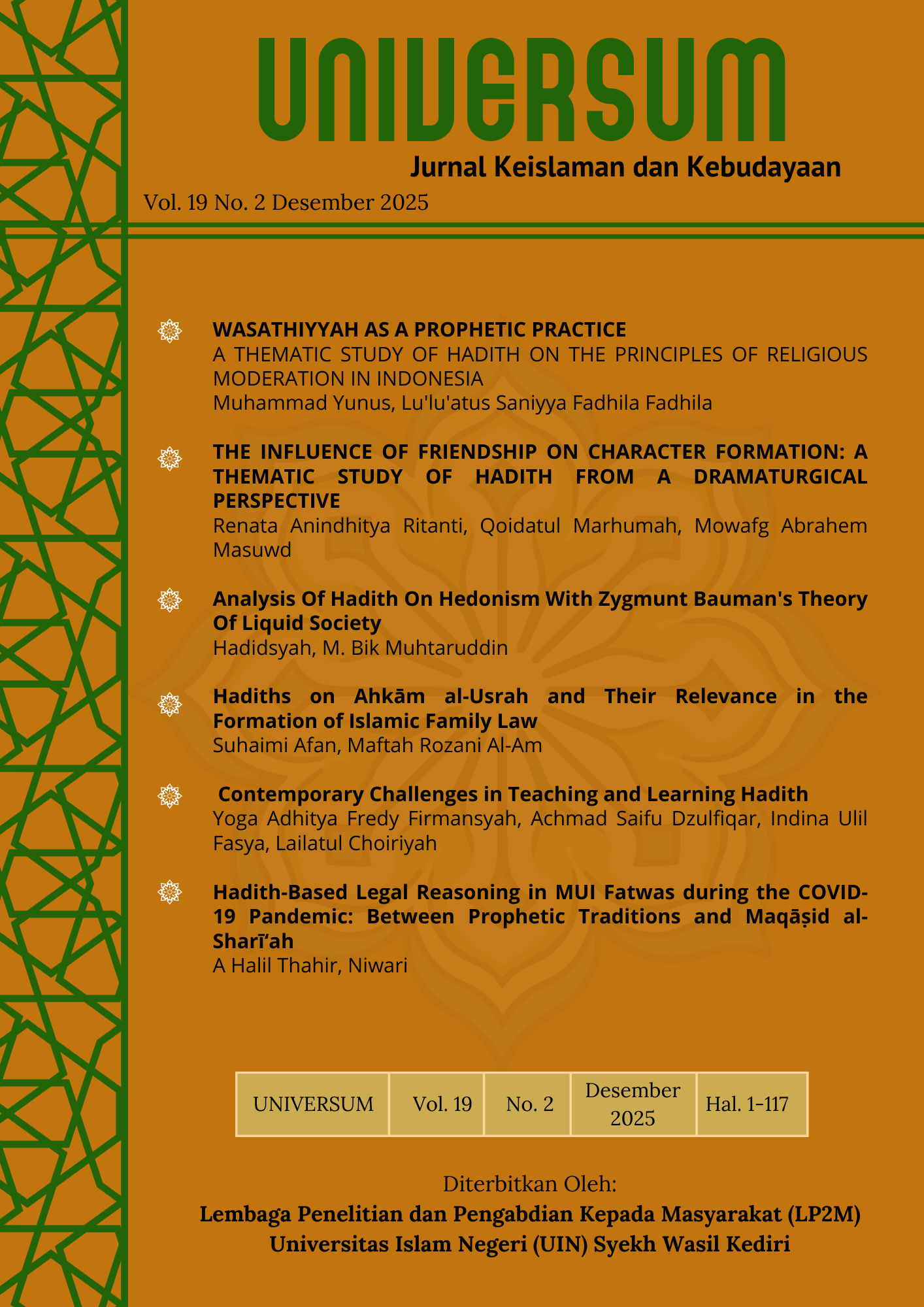
Analysis Of Hadith On Hedonism With Zygmunt Bauman's Theory Of Liquid Society
DOI:
https://doi.org/10.30762/universum.v19i2.3393Keywords:
Hadith Hedonism, Simplicity, Hadith, Liquid SocietyAbstract
Hedonism, as a lifestyle oriented toward worldly pleasures, has become increasingly prevalent in modern society, including among Muslims. This way of life contradicts the Islamic principle of moderation, which emphasizes balance, self-control, and proportionality in fulfilling one’s needs. This study aims to reexamine the values of simplicity through a hadith-based analysis in response to the challenges of hedonism in contemporary society. The research employs a qualitative approach through a literature study, applying thematic hadith analysis (maudhu‘i) combined with concise takhrij to ensure the authenticity of the narrations. Hadiths concerning the prohibition of excessiveness and the encouragement of simple living are analyzed contextually using Zygmunt Bauman’s Liquid Society theory. The findings reveal that the Prophet’s teachings on simplicity emphasize the importance of controlling consumption, fostering social concern through sharing, and maintaining balance between material and spiritual needs. Meanwhile, Bauman’s concept of liquid modernity exposes how consumerist culture and rapid social changes have eroded the values of moderation. The contribution of this study lies in integrating Hadith analysis with Bauman’s theory, producing a contextual interpretation that is relevant for critiquing modern hedonism. The study concludes that the actualization of simplicity values in the hadith represents a strategic principle for building a more stable and civilized social order amid the dynamics of liquid modern society.
Downloads
References
Adianto, A. (2023). Pengaruh Kepribadian, Conspicuous Consumption, Kecanduan Internet Terhadap Pembelian Kompulsif Pada Konsumen Marketplace Shopee Kota Bandung. Universitas Komputer Indonesia.
Ajmain, M., Alif, M., Lisalam, R. H., & others. (2025). MEMBANGUN KARAKTER SPIRITUAL MELALUI HADIS NABI: STUDI HADIS TEMATIK ATAS KONSEP ZUHUD. MAHAD ALY JOURNAL OF ISLAMIC STUDIES, 4(1), 1–21.
Al-Būṣīrī, A. ibn A. B. ibn I. (2004). Miṣbāḥ al-Zujājah fī Zawāʾid Ibn Mājah. Dār al-Kutub al-ʿIlmiyyah.
Al-Haythamī., N. al-D. ʿAlī ibn A. B. ibn S. (1994). Majmaʿ al-Zawāʾid wa Manbaʿ al-Fawāʾid. Dār al-Kutub al-ʿIlmiyyah.
Al-Mundhirī, A. al-ʿAẓīm ibn ʿAbd al-Q. ibn ʿAbd A. (2003). Al-Targhīb wa al-Tarhīb. Dār Ibn Kathīr.
Al-Sijistāni, A. D. S. bin al-A. bin S. bin I. bin B. bin ‘Amr bin ‘Imrān al-A. (2018). Sunan Abī Dāwūd. Jam’iyyah al-Maknaz al-Islāmī.
Ansori, I. H. (2018). Akal dan Agama Perempuan (Perspektif Hadis Nabi dan Psikologi). Universum, 12(1), 9–20.
Ansori, I. H. (2019). Hadis Ma’lul dan Kehujjahannya.
Ansori, I. H., & Fiddaroyni, F. S. (2023). Intertextuality of Hadith Regarding the Prohibition of Seeking Position. 127–142. https://doi.org/10.24252/ihyaussunnah.v3i1.35361
Aprilia, E. D., & Mahfudzi, R. (2017). Gaya hidup hedonisme dan impulse buying pada mahasiswa. Ecopsy, 7(2), 378660.
Aprilia, T. H. (2025). Human Resource Management in Improving the Quality of Education at State Primary School | Allimna: Jurnal Pendidikan Profesi Guru. https://jurnalfaktarbiyah.iainkediri.ac.id/index.php/allimna/article/view/5312
Aprilia, T. H., Masrof, A. H., & Humaidi, A. (2022). Pesantren In Social Construction Perspective (The Educational Orientation Of The Sidogiri Pesantren). TARLIM : JURNAL PENDIDIKAN AGAMA ISLAM, 5(2), 139–157. (discourse analysis). https://doi.org/10.32528/tarlim.v5i2.7903
Aprilia, T. H., & Munifah, M. (2022). Manifestation Of Prophetic Leadership Values In Islamic Education. Tadbir : Jurnal Studi Manajemen Pendidikan, 6(2), 273–285. https://doi.org/10.29240/jsmp.v6i2.4896
Aprilia, T. H., & Sufirmansyah, S. (2025). Santri and the Digital Divide: (The Upheaval of Pesantren Over Technological Developments in Cultural Lag Perspective). Briliant: Jurnal Riset Dan Konseptual, 10(3), 581–592. https://doi.org/10.28926/briliant.v10i3.2215
Aprillia, T. H., Masrof, A. H., Ahid, N., & Huda, S. (2023). Pesantren and Tradition (Study Of Ta’dzim Affiliates in Character Education Al-Ghazali and Thomas Lickona). Edukasi Islami: Jurnal Pendidikan Islam, 12(01). https://doi.org/10.30868/ei.v12i01.2738
Arif, M. (2015). Individualisme Global Di Indonesia (Studi Tentang Gaya Hidup Individualis Masyarakat Indonesia di Era Global). IAIN Kediri Press.
Ayyubi, M. S. A., & Aprilia, T. H. (2023). Hukuman Mati Bagi Murtad Perspektif Syekh Ali Jum’ah. Syariah: Journal of Fiqh Studies, 1(1), 43–60. https://doi.org/10.61570/syariah.v1i1.17
Bardhi, F., & Eckhardt, G. M. (2017). Liquid consumption. Journal of Consumer Research, 44(3), 582–597. https://doi.org/10.1093/jcr/ucx050
Bauman, Z. (2000). Liquid Modernity. Polity Press.
Best, S. (2016). Zygmunt Bauman: On what it means to be included. Power and Education, 8(2), 124–139.
Eko Sucipto Dwijo, A. Q. N., Fahmi, M., Azhari, S., Prasetia, S. A., & Al Farisi, S. (2022). Quranic-based Moderate Islam in Pesantren against Radicalism. Jurnal Pendidikan Agama Islam (Journal of Islamic Education Studies), 10(2), 129–148. https://doi.org/10.15642/jpai.2022.10.2.129-148
Faiz, Abd. A. (2018). Muslimah Perkotaan: Globalizing lifestyle, religion and identity (4th ed.). SUKA-Press.
Foltz, R. C., Denny, F. M., & Baharuddin, A. (2003). Islam and ecology: A bestowed trust. Massachusetts: Harvard University Press.
Hennink, M., Bailey, A., & Hutter, I. (2020). Qualitative research methods.
Ibnu Mājah, M. bin Y. A. A. (2018). Sunan Ibni Mājah. Jam’iyyah al-Maknaz al-Islāmī.
Kuntag, P., & Ohoitimur, J. (2025). MEDIA Jurnal Filsafat dan Teologi Membaca Liquid Society dari Perspektif Burnout Society. 6(1). https://doi.org/10.53396/media
Kurniawan, R. (2024). Konsep Liquid Life Menurut Zygmunt Bauman. Jurnal Seri Mitra (Refleksi Ilmiah Pastoral), 3(1), 186–196.
Muchtar, E. H. (2025). TAFSIR MAUDHU’I QS AL-ISRA’AYAT 26—27: SOLUSI QUR’ANI FENOMENA FOMO DAN GAYA HIDUP KONSUMTIF GEN-Z. Jurnal Ilmu Al-Qur’an Dan Tafsir (JIQTA), 4(1), 1–14.
Munifah, Aprilia, T. H., & Hamida, U. D. (2025). Asset Management Information Systemin Private Islamic College Environment. Al-Hayat: Journal of Islamic Education, 9(1), 159–180. https://doi.org/10.35723/ajie.v9i1.38
Nasr, S. H. (1996). Religion and the Order of Nature. Oxford University Press.
Ningrum, D. M., Aprilia, T. H., & Maduarawee, M. (2025). PAI Teacher’s Strategy in Improving Student Achievement at MAN PK MAN 4 Jombang. International Journal of Religion and Social Community, 3(1), 55–68. https://doi.org/10.30762/ijoresco.v3i1.3589
Palese, E. (2013). Zygmunt bauman. Individual and society in the liquid modernity. SpringerPlus, 2(1). https://doi.org/10.1186/2193-1801-2-191
Pormadi Simbolon, S. S., & Fil, M. (n.d.). Pemikiran Zygmunt Bauman: Problematika dan Prospek Kehidupan Terfragmentasi Masyarakat Posmodern. PT Kanisius.
Putri, A. S., Khayu, A., & Aprilia, T. H. (2024). Nilai-Nilai Islam Dalam Tradisi Tingkeban di Kelurahan Ngampel Kota Kediri. Al-Mabsut : Jurnal Studi Islam dan Sosial, 18(1), 127–136. https://doi.org/10.56997/almabsutjurnalstudiislamdansosial.v18i1.1534
Ridwan, R., & others. (2025). Kontribusi Sosiologi Dakwah dalam Menghadapi Generasi Milenial: Contribution of the Sociology of Da’wah in Facing the Millennial Generation. DIRASAH: Jurnal Kajian Islam, 2(1), 177–191.
Robin, R. (2017). Social Climber dan Budaya Pamer: Paradoks Gaya Hidup Masyarakat. UIN-Maliki Press, 2, 117–136.
Salsabella, D. Q., Muna, N., & Ansori, I. H. (2024). Moderasi Beragama dalam Tafsir al-Azhar Sebagai Pilar Karakter Anak Usia Dini. Al-Wasatiyah: Journal of Religious Moderation, 3(2), 213–247. https://doi.org/10.30631/jrm.v3i2.80
Sari, N., Munfarida, A., Andrasari, M. F., & others. (2024). Dampak Media Sosial terhadap Gaya Hidup dan Identitas Budaya Generasi Muda. DINASTI: Jurnal Sosial Dan Budaya, 1(01), 36–44.
Shobirin, M., Rosyadi, R. N., Sari, E. F., & others. (2025). Tantangan Dan Problematika Masyarakat Modern. Cahya Ghani Recovery.
Subakir, A., Mujab, S., & Aprilia, T. H. (2024). LIVING HADIS DALAM DAKWAH KULTURAL KYAI AGENG MUHAMMAD BESARI: RELASI SANTRI–PRIYAYI DI TEGALSARI–PONOROGO (1742–1773 M). UNIVERSUM: Jurnal Keislaman Dan Kebudayaan, 18(2). https://jurnalfuda.iainkediri.ac.id/index.php/universum/article/view/3659
Downloads
Published
How to Cite
Issue
Section
License
Copyright (c) 2025 Hadidsyah, M. Bik Muhtaruddin

This work is licensed under a Creative Commons Attribution 4.0 International License.