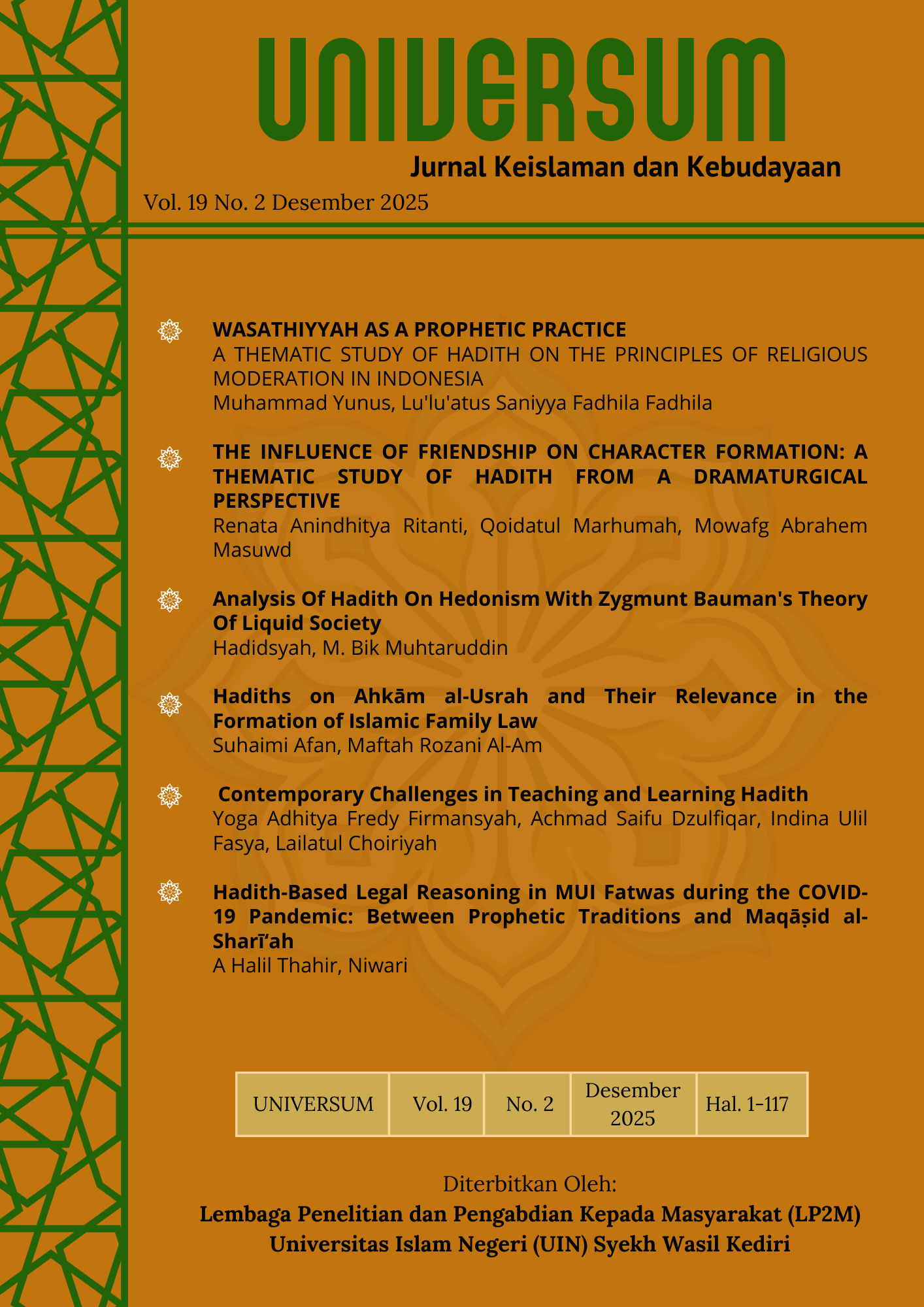
The Influence Of Friendship On Character Formation: A Thematic Study Of Hadith From A Dramaturgical Perspective
DOI:
https://doi.org/10.30762/universum.v19i2.3392Keywords:
Hadith, Social Relations, Thematic StudiesAbstract
In the creation of a perfect human being, humans are unable to live alone without the presence of others. Seeing the reality, humans do need interaction between one another. From these interactions, some are mutually beneficial and some are detrimental. However, building a relationship, one of which is friendship, is not an easy thing. Because, everyone has their own nature and character. In real life, there are indeed detrimental friendship relationships, which only benefit one party and harm the other party. Therefore, this article was written to examine several issues related to the influence of friendship, to be used as an answer and understanding of existing problems. This article uses a qualitative method with a library research pattern or thematic hadith study literature research. The use of primary sources in this study is the hadith about friendship sourced from canonical hadith books, such as the books of Sahih Bukhari, Muslim, and others. While the secondary sources are narratives or articles related to the theme of the study. The study includes an analysis of the quality and quantity of hadith about friendship through takhrij and i’tibar sanad. Then how is the dramaturgy theory by Erving Goffman, and how is the interpretation of hadith with the perspective of the dramaturgy theory. The results of the study show that friendship has a significant influence on the formation of a person's character. Social interaction of friendship can shape social behavior positively or negatively. The hadith used is the hadith of Imam Bukhari about the importance of choosing friends. The analysis of the sanad of this hadith is declared to be valid in quality, because the sanad of the hadith is continuous, the narrator is 'fair and dabit. Furthermore, regarding the matan hadith, no irregularities or defects were found, nor do they contradict the verses of the Qur'an, authentic hadiths, historical facts, and scientific truths.
Downloads
References
Absari, D. M. (2025). Fenomena Pengemis Jalanan di Indonesia dalam Perspektif Teori Dramaturgi Erving Goffman. Jurnal Locus Penelitian Dan Pengabdian, 4(5), 2077–2086. https://doi.org/10.58344/locus.v4i5.4183
Ahnaf, M. A. A., & Alif, M. (2025). TOXIC RELATIONSHIP DALAM AL-QUR’AN, STUDI QUR’AN TEMATIK DENGAN PENDEKATAN GROUNDED THEORY. JUTEQ: JURNAL TEOLOGI & TAFSIR, 2(7), 1263–1274.
al-A‘zami, M. M. (1977). Studies in Hadith Methodology and Literature. Indianapolis: American Trust Publication.
al-Bukhari, M. bin I. (1987). Shahih al-Bukhari. Beirut: Dar Ibn Katsir.
al-Hajjaj, M. bin. (1991). Shahih Muslim. Beirut: Dar Ihya’ al-Turats al-‘Arabi.
Alchusyairi, M. F., & Ansori, I. H. (2024). The Term Dekengane Pusat and its Relevance to the Hadith of Al-Bukhari No. 6502: A Study of Fazlur Rahman’s Hadith Hermeneutics. International Journal of Religion and Social Community, 2(2), 105–122. https://doi.org/10.30762/ijoresco.v2i2.3510
Alimah, F., & Fauzie, M. F. R. (2025). Fenomena Fantasi Sedarah Di Media Sosial Perspektif Hadis Tematik. Jurnal Kajian Islam Dan Sosial Keagamaan, 2(4), 863–869.
Alwi, M. B. (2023). TAFSIR SURAT AL-TÎN DALAM TAFSIR AL-TAHRÎR WA AL-TANWÎR PRESPEKTIF MAQÃSID AL-QUR’ÃN. Jurnal Ilmiah Spiritualis: Jurnal Pemikiran Islam dan Tasawuf, 9(2), 301–334. https://doi.org/10.53429/spiritualis.v9i2.722
Amelia, L., & Amin, S. (2022). ANALISIS SELF-PRESENTING DALAM TEORI DRAMATURGI ERVING GOFFMAN PADA TAMPILAN INSTAGRAM MAHASISWA. Dinamika Sosial: Jurnal Pendidikan Ilmu Pengetahuan Sosial, 1(2), 173–187. https://doi.org/10.18860/dsjpips.v1i2.1619
Ansori, I. H., & Fadhila, L. S. (2025). Interpretasi Hadis tentang Memuliakan Wanita dan Implikasinya dalam Membangun Keluarga Harmonis Perspektif Husein Muhammad. JADID: Journal of Quranic Studies and Islamic Communication, 5(01), 21–38. https://doi.org/10.33754/jadid.v5i01.1291
Ansori, I. H., Wilwadikta, Q. P., Prafita, E. D. I. M., & Gunawan, A. (2023). Meaning Construction in Ancak Tradition: A Study of Living Qur’an. QOF, 7(2), 301–316. https://doi.org/10.30762/qof.v7i2.1446
Aprilia, T. H. (2025). Human Resource Management in Improving the Quality of Education at State Primary School | Allimna: Jurnal Pendidikan Profesi Guru. https://jurnalfaktarbiyah.iainkediri.ac.id/index.php/allimna/article/view/5312
Aprilia, T. H., Masrof, A. H., & Humaidi, A. (2022). Pesantren In Social Construction Perspective (The Educational Orientation Of The Sidogiri Pesantren). TARLIM : JURNAL PENDIDIKAN AGAMA ISLAM, 5(2), 139–157. (discourse analysis). https://doi.org/10.32528/tarlim.v5i2.7903
Aprilia, T. H., & Munifah, M. (2022a). Manifestation Of Prophetic Leadership Values In Islamic Education. Tadbir : Jurnal Studi Manajemen Pendidikan, 6(2), 273–285. https://doi.org/10.29240/jsmp.v6i2.4896
Aprilia, T. H., & Munifah, M. (2022b). Manifestation Of Prophetic Leadership Values In Islamic Education. Tadbir : Jurnal Studi Manajemen Pendidikan, 6(2), 273–285. https://doi.org/10.29240/jsmp.v6i2.4896
Aprilia, T. H., & Sufirmansyah, S. (2025). Santri and the Digital Divide: (The Upheaval of Pesantren Over Technological Developments in Cultural Lag Perspective). Briliant: Jurnal Riset Dan Konseptual, 10(3), 581–592. https://doi.org/10.28926/briliant.v10i3.2215
Aprillia, T. H., Masrof, A. H., Ahid, N., & Huda, S. (2023). Pesantren and Tradition (Study Of Ta’dzim Affiliates in Character Education Al-Ghazali and Thomas Lickona). Edukasi Islami: Jurnal Pendidikan Islam, 12(01). https://doi.org/10.30868/ei.v12i01.2738
Ayyubi, M. S. A., & Aprilia, T. H. (2023). Hukuman Mati Bagi Murtad Perspektif Syekh Ali Jum’ah. Syariah: Journal of Fiqh Studies, 1(1), 43–60. https://doi.org/10.61570/syariah.v1i1.17
Basid, A., & Rahmah, W. (2023). Melawan Cyberbullying: Membangun Kesadaran Kemanusiaan dalam Etika Bermedia Sosial Perspektif Al-Qurâ€TMan. Studia Quranika, 7(2), 203–231. https://doi.org/10.21111/studiquran.v7i2.9013
Bonner, H. (1953). Social psychology an interdisciplinary approach. New York,American Book Company.
Burke, K. (1969). A Rhetoric of Motives. Los Angeles: University of California Press.
Butar, N. A. B. (2024). TOXIC PEOPLE DAN DAMPAKNYA DI DALAM AL-QUR’AN (ANALISIS TERHADAP PENAFSIRAN BUYA HAMKA DALAM TAFSIR AL AZHAR). Jurnal Ushuluddin, 20(1), 17–48. https://doi.org/10.51900/ushuluddin.v20i1.22505
Chanifah, N., Samsudin, A., & Ansori, I. H. (2024). Quranic Leadership: The Effort to Realize the Integrity of Leaders in Preventing Corruption. International Journal of Educational Management & Innovation, 5(1), 24. https://doi.org/10.12928/ijemi.v5i1.9173
Damayanti, F. F. (2023). PERSPEKTIF DRAMATURGI ERVING GOFFMAN PADA APARAT KEPOLISIAN DALAM MENGHADAPI KASUS VIRAL. Journal Analytica Islamica, 12(1), 63–71. https://doi.org/10.30829/jai.v12i1.14015
Erving, G. (1956). The Presentation of Self in Everyday Life. Edinburgh: University of Edinburgh Social Sciences Research Centre.
Goffman, E. (1959). The Presentation of Self in Everyday Life. New York: Anchor Books.
Huda, K. N., Saleh, A. H., Mukaromah, K., & Ansori, I. H. (2023). Perkembangan Kajian Hadis dalam Ranah Digital. Gunung Djati Conference Series, 29, 69–75.
Iqbal, M. F., Handoyo, P., & Harianto, S. (2024). Nongkrong dalam perspektif Dramaturgi Erving Goffman. Dimensia: Jurnal Kajian Sosiologi, 13(1), 1–12. https://doi.org/10.21831/dimensia.v13i1.65282
Irawan, R., & Alif, M. (2025a). Memilih Circle dalam Perspektif Hadis: Panduan Praktis untuk Menjalani Kehidupan Berlandaskan Ajaran Agama. TADHKIRAH: Jurnal Terapan Hukum Islam Dan Kajian Filsafat Syariah, 2(3), 45–55. https://doi.org/10.59841/tadhkirah.v2i3.237
Irawan, R., & Alif, M. (2025b). Memilih Circle dalam Perspektif Hadis: Panduan Praktis untuk Menjalani Kehidupan Berlandaskan Ajaran Agama. TADHKIRAH: Jurnal Terapan Hukum Islam Dan Kajian Filsafat Syariah, 2(3), 45–55. https://doi.org/10.59841/tadhkirah.v2i3.237
Iuliatno, M. A., & Rosyadi, S. (2024). Toxic di Media Sosial dalam Perspektif Hadis dengan Metode Tematik. Jurnal Manajemen Dan Pendidikan Agama Islam, 2(5), 284–295. https://doi.org/10.61132/jmpai.v2i5.541
Junadi, M. (2017). Manusia dalam berbagai Perspektif. Dar El-Ilmi : Jurnal Studi Keagamaan, Pendidikan Dan Humaniora, 4(1), 35–55. https://doi.org/10.52166/dar
Khamim, K., Hijriyati, M., Ansori, I. H., & Fauriz, M. H. (2024a). Livelihood Responsibility Shifting to Migrant Worker Wives; A Reading of Qur’an and Hadith in Muslim Community. AL-IHKAM: Jurnal Hukum & Pranata Sosial, 19(2), 574–602. https://doi.org/10.19105/al-lhkam.v19i2.11109
Khamim, K., Hijriyati, M., Ansori, I. H., & Fauriz, M. H. (2024b). Livelihood Responsibility Shifting to Migrant Worker Wives; A Reading of Qur’an and Hadith in Muslim Community. AL-IHKAM: Jurnal Hukum & Pranata Sosial, 19(2), 574–602. https://doi.org/10.19105/al-lhkam.v19i2.11109
Khusna, O. W., Maghfiroh, L. R. E., Chairiani, A., & Ansori, I. H. (2023). PEMAHAMAN AYAT WASATHIYYAH DAN PENERAPANNYA DALAM MEMBANGUN KERUKUNAN UMAT BERAGAMA DI LINGKUNGAN KANTOR URUSAN AGAMA KECAMATAN GURAH KEDIRI. JADID: Journal of Quranic Studies and Islamic Communication, 3(02), 15–30. https://doi.org/10.33754/jadid.v3i01.592
Munifah, Aprilia, T. H., & Hamida, U. D. (2025). Asset Management Information Systemin Private Islamic College Environment. Al-Hayat: Journal of Islamic Education, 9(1), 159–180. https://doi.org/10.35723/ajie.v9i1.38
Nida, H. A. (2021). Konsep Memilih Teman yang Baik Menurut Hadis. Jurnal Riset Agama, 1(2), 338–353. https://doi.org/10.15575/jra.v1i2.14571
Ningrum, D. M., Aprilia, T. H., & Maduarawee, M. (2025). PAI Teacher’s Strategy in Improving Student Achievement at MAN PK MAN 4 Jombang. International Journal of Religion and Social Community, 3(1), 55–68. https://doi.org/10.30762/ijoresco.v3i1.3589
Prihandoyo, M. D., & Liestyasari, S. I. (2025). ANALISIS DRAMATURGI ERVING GOFFMAN DALAM IMPLEMENTASI SEKOLAH RAMAH ANAK DI SMA NEGERI 1 SURAKARTA. Pendas : Jurnal Ilmiah Pendidikan Dasar, 10(01), 343–355. https://doi.org/10.23969/jp.v10i01.22490
Putri, A. S., Khayu, A., & Aprilia, T. H. (2024). Nilai-Nilai Islam Dalam Tradisi Tingkeban di Kelurahan Ngampel Kota Kediri. Al-Mabsut : Jurnal Studi Islam dan Sosial, 18(1), 127–136. https://doi.org/10.56997/almabsutjurnalstudiislamdansosial.v18i1.1534
Putri, S. M., & Apriadi, D. W. (2023). Dramaturgi dalam Motif Sharing di Instagram pada Mahasiswa Fakultas Ilmu Sosial Universitas Negeri Malang. Jurnal Komunikasi Nusantara, 5(1), 31–42. https://doi.org/10.33366/jkn.v5i1.249
Rohma, D. P. A., Kausar, A. A., Huda, M. I. W. A., Ansori, I. H., & Tawajok, D. F. A. K. (2025). Figurative Rhetoric about the Transiency of the World in the Qur’an: An Analysis of Tashbīh Qs. Al-Kahf [18]: 45. International Journal of Religion and Social Community, 3(2), 45–62. https://doi.org/10.30762/ijoresco.v3i2.3601
Romdhonah, R., & Millah, M. (2024). Studi Tematik Hadis Toxic Friendship dengan Pendekatan Akhlak. Al-Tarbiyah : Jurnal Ilmu Pendidikan Islam, 2(4), 108–120. https://doi.org/10.59059/al-tarbiyah.v2i4.1433
Salsabella, D. Q., Muna, N., & Ansori, I. H. (2024). Moderasi Beragama dalam Tafsir al-Azhar Sebagai Pilar Karakter Anak Usia Dini. Al-Wasatiyah: Journal of Religious Moderation, 3(2), 213–247. https://doi.org/10.30631/jrm.v3i2.80
Subakir, A., Mujab, S., & Aprilia, T. H. (2024). LIVING HADIS DALAM DAKWAH KULTURAL KYAI AGENG MUHAMMAD BESARI: RELASI SANTRI–PRIYAYI DI TEGALSARI–PONOROGO (1742–1773 M). UNIVERSUM: Jurnal Keislaman Dan Kebudayaan, 18(2). https://jurnalfuda.iainkediri.ac.id/index.php/universum/article/view/3659
UMMAH, N. H. (2022). TOXIC FRIENDSHIP PERSPEKTIF HADIS Kajian Tematik Hadis-Hadis Tentang Pertemanan [Skripsi]. Institut Agama Islam Negeri Kediri.
Zahra, A. A., Ansori, I. H., & Samsudin, A. (2024a). PERNIKAHAN USIA DINI DALAM PERSPEKTIF HADIS: TELAAH KONTEMPORER MELALUI PENDEKATAN PSIKOLOGI. Canonia Religia, 2(1), 1–20. https://doi.org/10.30762/cr.v2i1.1817
Zahra, A. A., Ansori, I. H., & Samsudin, A. (2024b). PERNIKAHAN USIA DINI DALAM PERSPEKTIF HADIS: TELAAH KONTEMPORER MELALUI PENDEKATAN PSIKOLOGI. Canonia Religia, 2(1), 1–20. https://doi.org/10.30762/cr.v2i1.1817
Zahro, F., Fitriana, A. Q. Z., & Bisri, M. K. (2025). Pengaruh Pertemanan “Toxic” terhadap Kesejahteraan Psikologis dan Perkembangan Sosial Remaja SMA. Complex : Jurnal Multidisiplin Ilmu Nasional, 2(2), 153–159.
Downloads
Published
How to Cite
Issue
Section
License
Copyright (c) 2025 Renata Anindhitya Ritanti, Qoidatul Marhumah, Mowafg Abrahem Masuwd

This work is licensed under a Creative Commons Attribution 4.0 International License.