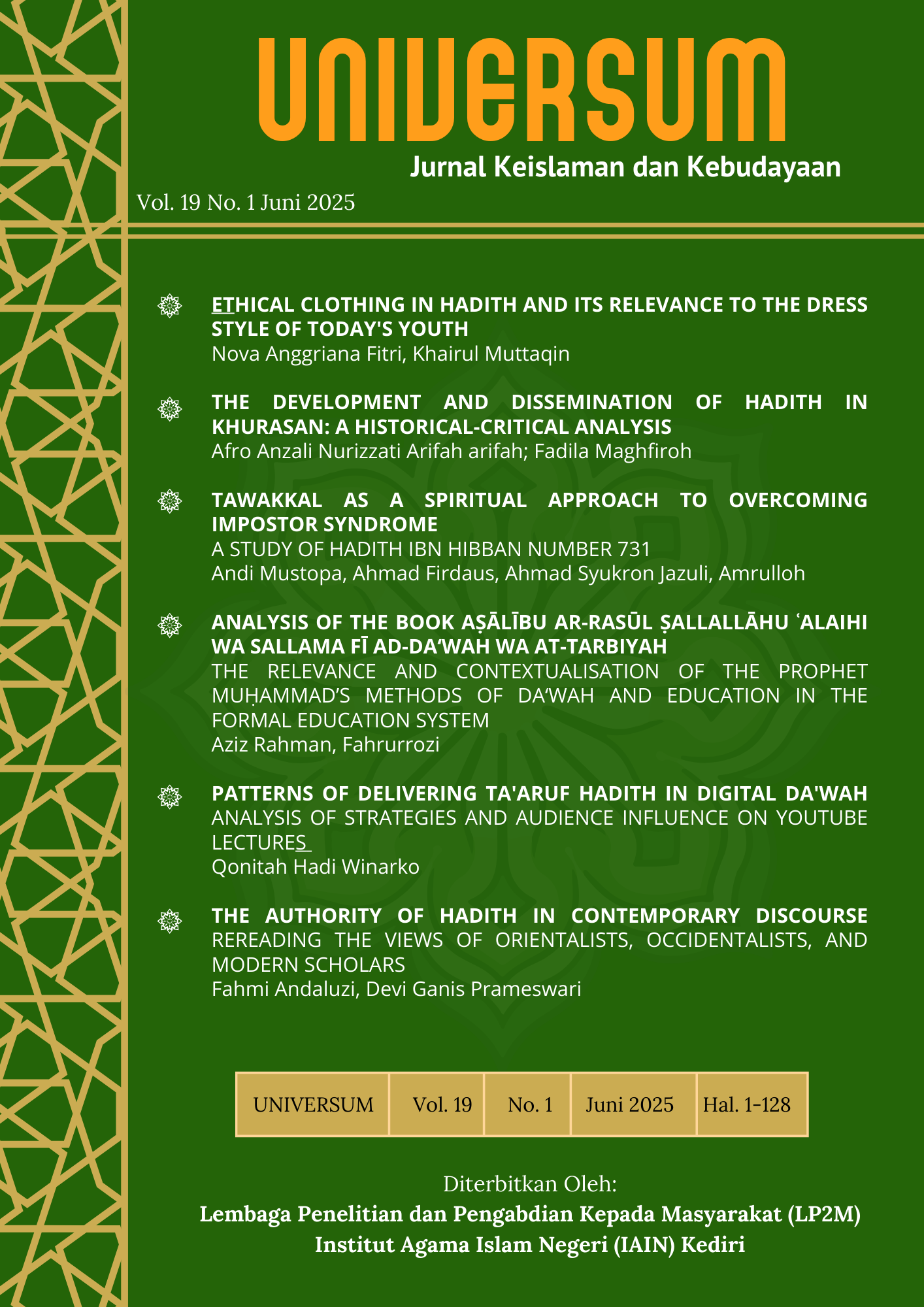
THE AUTHORITY OF HADITH IN CONTEMPORARY DISCOURSE
REREADING THE VIEWS OF ORIENTALISTS, OCCIDENTALISTS, AND MODERN SCHOLARS
DOI:
https://doi.org/10.30762/universum.v19i1.3353Keywords:
Ḥadīth Criticism, Authority, Contemporary Discourse, Orientalism.Abstract
Hadith constitutes an authoritative source of Islamic law after the Qur’an. However, throughout its history, its authority has been subject to continuous re-examination, both through isnād (chain of transmission) and matn (content) criticism. This article examines contemporary discourses on ḥadīth criticism and their implications for the authority of hadith by tracing classical and modern literature and comparing them with the views of contemporary Muslim hadith scholars. The findings reveal that contemporary hadith discourse can be mapped into three major perspectives: Orientalists, Occidentalists, and contemporary Muslim scholars. Orientalists such as Goldziher, Schacht, Juynboll, and others, who predominantly employed historical criticism as their main analytical tool, tend to regard hadith as a later socio-political construct, thereby casting doubt on its authority to a significant extent. Their critiques have influenced certain Occidentalist figures who highlight methodological weaknesses within the hadith tradition, particularly in transmission, codification, and the subjective nature of isnād evaluation, with a stronger emphasis on matn criticism. While the critiques of Orientalists and their resonance among modern Muslim thinkers reflect a concern that has encouraged more rigorous and comprehensive engagement with hadith studies among contemporary scholars, they often remain reductive and ahistorical. In response, contemporary hadith scholars such as Nūr al-Dīn ʻItr, al-Idlibī, al-Sibāʿī, and al-Jawābī assert that both isnād and matn criticism had in fact been practiced since the early period, even though methodological frameworks were conceptually systematized at a later stage. Consequently, the substantive authority of hadith as a normative Islamic text remains intact. This article underscores the relevance and urgency of hadith criticism methodologies in addressing modern challenges while reaffirming the central position of hadith within Islamic authority.
Downloads
References
Akbari, M. F., Hudaya, H., & Munawwarah, H. (2025). Metode Kritik Matan Hadis Perspektif Ulama Hadis. Al-Falah: Jurnal Ilmiah Keislaman Dan Kemasyarakatan, 25(1), 15–31.
Al-Baghdādī, A. B. A. ibn ʿAlī al-K. (n.d.). al-Jāmiʿ li Akhlāq al-Rāwī wa Ādāb al-Sāmiʿ (M. Al-Ṭaḥḥān (ed.)). Maktabah al-Maʿārif li-al-Nasyr wa-al-Tauzīʿ.
Al-Ḥākim, A. ʻAbd A. M. ibn ʻAbd A. (1990). al-Mustadrak ʻalā al-Ṣaḥīḥain (M. ʻAbd al-Q. ʻAṭā (ed.)). Dār al-Kutub al-ʻIlmiyyah.
Al-ʻAsqalāniy, A. I. ʻAlī. (1404). al-Nukat ʻalā Kitāb Ibn al-Ṣalāḥ. ʻAmādah al-Baḥṡ al-ʻIlmiy bi al-Jāmiʻah al-Islāmiyah.
Al-ʻAsqalāniy, A. I. ʻAlī. (2000). Nuzhah al-Naẓar fī Tauḍīḥ Nukhbah al-Fikar fī Muṣṭalaḥ Ahl al-Aṡar. Maṭbaʻah al-Ṣabāḥ.
Al-Idlibiy, Ṣalāḥ al-Dīn ibn Aḥmad. (2013). Manhaj Naqd al-Matn ʻind ʻUlamā’ al-Ḥadīṡ al-Nabawiy. Muassasah Iqra’ al-Khairiyyah.
Al-Jawābiy, M. Ṭāhir. (n.d.). Juhūd al-Muḥaddiṡīn Fi Naqd Matn al-Ḥadīṡ al-Nabawiy al-Syarīf. Muassasah ʻAbd al-Karīm Ibn ʻAbdillāh.
Al-Mālikiy, M. ibn ʻAlwī. (2000). al-Manhal al-Laṭīf Fī Uṣūl al-Ḥadīṡ al-Syarīf (7th ed.). Maktabah al-Mālik Fahd.
Al-Muḥammadiy, ʻAbd al-Qādir ibn Muṣṭafā. (n.d.). al-Riwāyah fī Ḍawābit Naqd al-Riwāyah ʻind al-Ṣaḥābah.
Al-Qārī, ʻAlī ibn Sulṭān. (n.d.). Syarḥ Syarḥ Nukhbah al-Fikar fī Muṣṭalaḥ Ahl al-Aṡar. Syirkah Dār al-Arqam ibn Abī al-Arqam.
Al-Qazwīniy, I. M. M. ibn Y. (n.d.). Sunan ibn Mājah (M. F. ʻAbd al-Bāqī (ed.); Vols. 1–2). Dār Iḥyā’ al-Kutub al-ʻArabiyyah. https://shamela.ws/book/1198
Al-Sibāʻī, M. (2000). al-Sunnah wa Makānatuhā fī al-Tashrīʻ al-Islāmī. Dār al-Warrāq.
Al-Sulamiy, ʻIyāḍ ibn Nāmī. (1426). Uṣūl al-Fiqh Allażī Lā Yasaʻ al-Faqīh al-Jahlah. Dār al-Tadmuriyyah.
Al-Ṭaḥḥān, M. (2004). Taisīr Muṣṭalaḥ al-Ḥadīṡ (10th ed.). Maktabah al-Maʻārif.
Al-Zuḥailī, M. M. (1427). al-Wajīz fī Uṣūl al-Fiqh al-Islāmī. Dār al-Khair.
Al-Zuhailiy, W. (1406). Uṣūl al-Fiqh al-Islāmiy. Dār al-Fikr.
Al-ʿAfānī, S. ibn Ḥusain ibn ʿAbd A. (2004). Aʿlām wa Aqzām fī Mīzān al-Islām. Dār Mājid ʿUsairī.
Amrullah, A., Harun, A., & Sakti, I. J. (2025). Persepsi Orientalis terhadap Hadis: Kajian Epistemologi. Al-Mustafid: Journal of Quran and Hadith Studies, 4(1), 20–32.
Bahā’ al-Dīn, M. (1999). al-Mustasyriqūn wa al-Ḥadīs al-Nabawī. Dār al-Fākis.
Brown, J. A. C. (2009). Hadith: Muhammad’s Legacy in the Medieval and Modern World. Universitas Michigan.
Candra, H., Fauzi, A., Ghozali, A., & Asriady, M. (2021). Kritik Mustafa Al-Siba’I terhadap Ahmad Amin Tentang Keabsahan Hadis. Bertuah, 2(2), 44–58.
Fauzi, I., Fadhlurrahman, Z., & Rachman, M. A. (2025). Kritik Matan Hadis Dispensasi Abu Lahab dalam Bingkai Shalahuddin Al-Idlibi. Journal of Hadith Studies, 8(1), 1–19.
Harahap, A. F. (2024). Hadis dan Kesarjanaan Timur. Al-Thiqah: Journal of Hadith and Prophetic Tradition, 4(1), 19–26.
ʻItr, N. al-D. (1981). Manhaj al-Naqd Fī ʻUlūm al-Ḥadīṡ. Dār al-Fikr.
Khalaf, N. ʻAbd al-R. (1989). Naqd al-Matn bayna Ṣinā‘ah al-Muḥaddiṡīn wa Maṭā‘in al-Mustasyriqīn. Maktabah al-Rusyd.
Lisalam, R. H. (2019). Kehujjahan Hadits Mauquf Menurut Muhadditsin: Studi Analisis Terhadap Kedudukan Hadits Mauquf Sebagai Sumber Hukum Islam. Pustaka Sedayu.
Millah, M. idul, & Luthfi, H. (2021). Bertafsir Ala Schleiermacher. Misykah: Jurnal Pemikiran Dan Studi Islam, 6(1), 50–61.
Rizqi, A., Basya, H., Hakim, L., & Bahri, S. (2025). Hadits sebagai Sumber Hukum Islam Menurut Orientalis. Cerdika: Jurnal Ilmiah Indonesia, 5(6).
Syaʻbān, Z. al-D. (1971). Uṣūl al-Fiqh al-Islāmiy. Dār al-Kutub.
Syiblī, M. M. (n.d.). Uṣūl al-Fiqh al-Islāmiy. Dār al-Jāmiʻah.
Wahyuddin, I., & Syauqani, S. (2025). Orientalisme dalam Kajian Hadis: Telaah Historis, Ruang Lingkup, dan Pemikiran Kaum Orientalis terhadap Tradisi Hadis Nabi. DIRAYAH: Jurnal Ilmu Hadis, 5(2), 190–205.
Downloads
Published
How to Cite
Issue
Section
License
Copyright (c) 2025 Fahmi Andaluzi, Devi Ganis Prameswari

This work is licensed under a Creative Commons Attribution 4.0 International License.