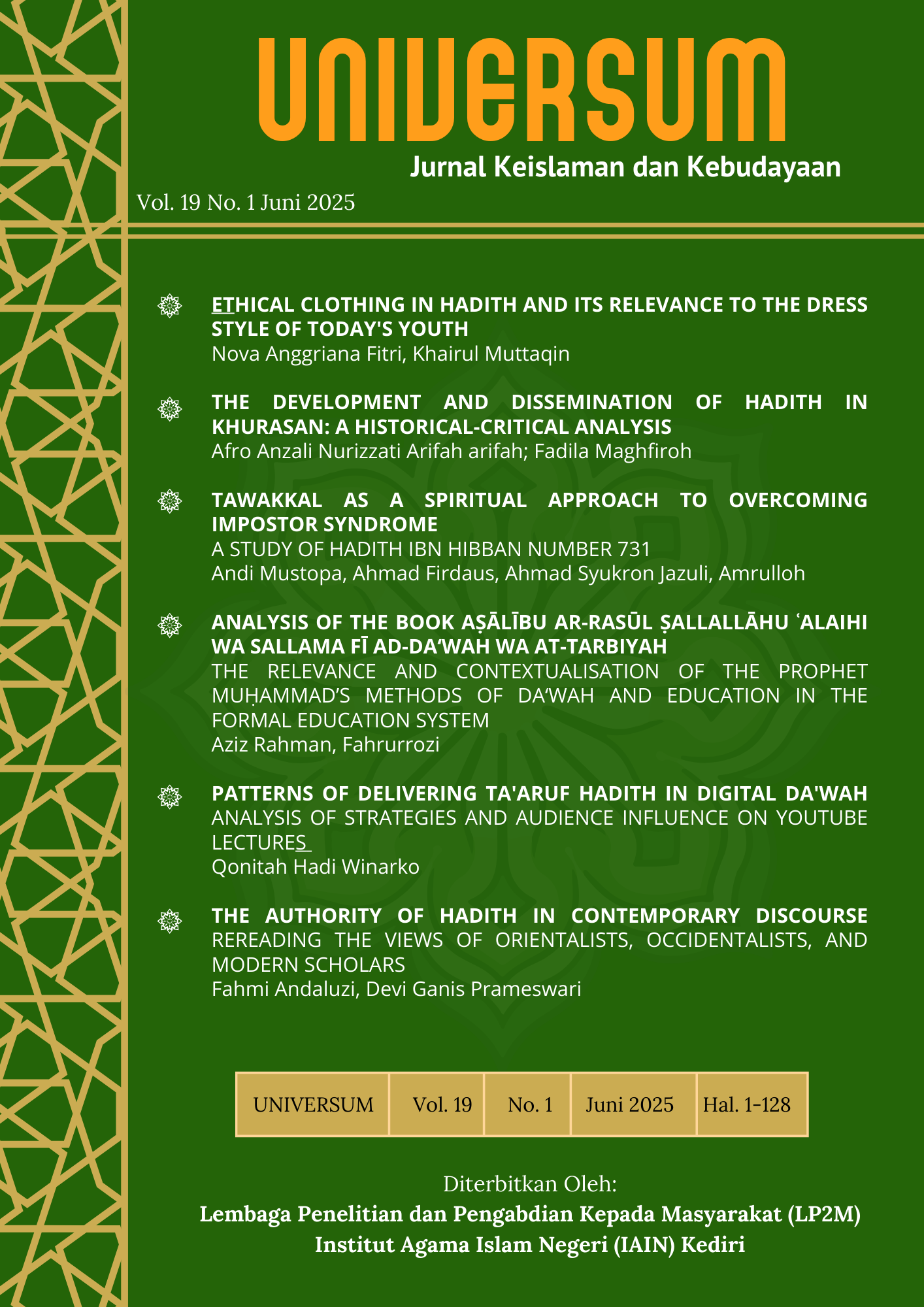
ETHICAL CLOTHING IN HADITH AND ITS RELEVANCE TO THE DRESS STYLE OF TODAY'S YOUTH
DOI:
https://doi.org/10.30762/universum.v19i1.3150Keywords:
Clothing Ethics, Hadith, Muslim Youth, Islamic FashionAbstract
This study discusses the concept of clothing ethics in the Hadith and its relevance to the dressing style of contemporary Muslim youth. In Islam, clothing is not merely a physical or cultural necessity but also a moral and spiritual obligation that reflects faith, modesty, and personal dignity. This research employs a library research method with a thematic-conceptual approach to the Hadith, drawing on primary sources from Kutub al-Tis’ah and secondary references such as classical commentaries, scholarly books, and academic journals. The findings reveal that the Prophet’s traditions emphasize several key principles of dress: covering the body appropriately, avoiding arrogance and extravagance in clothing, refraining from imitating the opposite gender, and maintaining simplicity and sincerity of intention. These values remain highly relevant in the modern context, where fashion trends often create a dilemma between religious commitment and popular cultural influences. Therefore, Islamic educational institutions are encouraged to develop a more humanistic and educational approach to da’wah to guide young generations to balance self-expression with moral responsibility. The Hadith-based ethics of clothing can serve as a timeless guide for Muslim youth to express a modern identity while remaining virtuous and dignified.
Downloads
References
Ansharullah. (2019). Pakaian Muslimah Dalam Perspektif Hadis Dan Hukum Islam. Diktum: Jurnal Syariah Dan Hukum, 17(1).
Dessy Monica Pane, Dkk. (2018). Fashion Sebagai Penciptaan Identitas Diri Remaja Di Kota Denpasar. Sorot.
Fauzi, A. (2016). Pakaian Wanita Muslimah Dalam Perspektif Hukum Islam.
Iqtishodia: Jurnal Ekonomi Syariah, 1(1), 41–58. Https://Doi.Org/10.35897/Iqtishodia.V1i1.56
Imam Abu Dawud. Sunan Abu Dawud. Al-Maktabah Al-Syamilah, Juz 4, Hadis No. 4018.
Imam Abu Dawud. Sunan Abu Dawud: Vol. Juz. 4, Hadis No. 4031.
Imam Ahmad. Musnad Ahmad Bin Hanbal,: Vol. Juz 2, Hadis No. 7083. AlMaktabah Al-Syamila.
Imam An-Nawawi. (2013). Syarah Shahih Muslim. Jakarta: Darus Sunnah.
Imam Muslim. Shahih Muslim: Vol. Juz 1, Hadis No. 794. Al-Maktabah AlSyamilah.
Murtopo, B. A. (2017). Etika Berpakaian Dalam Islam: Tinjauan Busana Wanita Sesuai Ketentuan Islam. Tajdid: Jurnal Pemikiran Keislaman Dan Kemanusiaan, 1(2), 243–251. Https://Doi.Org/10.52266/Tadjid.V1i2.48
Nashiruddin Al-Albani, M. (2010). Kriteria Busana Muslimah. Jakarta : Pustaka Imam Asy Syafii.
Nasyah, R., & Wilianca, D. A. (2024). Hijab Trend: Combining Religious Values And Modern Fashion.
Quraish Shihab. (2004). Jilbab. Jakarta : Lentera Hati.
Rahmawati, T., & Khunaifi, A. (2019). Etika Berpakaian Dalam Islam. 3(1).
Silviani, P., & Rizqi, S. (2025). Etika Berpakaian Dan Relevansinya Dengan Pendidikan Islam Kajian Ayat (Q.S Al-A’raf Ayat 26-27). 5.
Sulaiman, S. (2005). Shalihah Kiat Mendidik Anak Perempuan Dalam Islam. Semarang: Pustaka Adnan.
Downloads
Published
How to Cite
Issue
Section
License
Copyright (c) 2025 Nova Anggriana Fitri, Khairul Muttaqin

This work is licensed under a Creative Commons Attribution 4.0 International License.