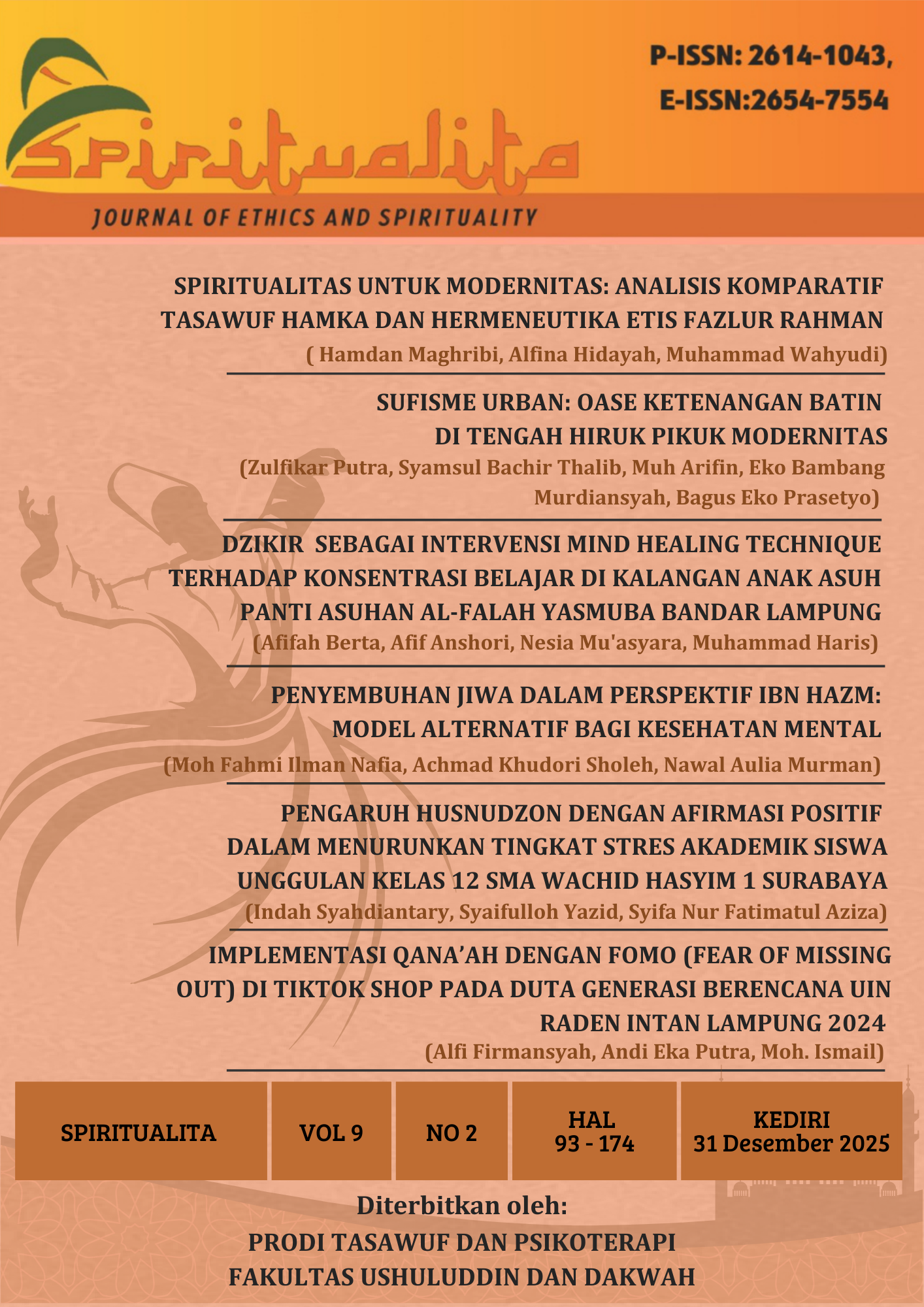
Spiritualitas untuk Modernitas: Analisis Komparatif Tasawuf Hamka dan Hermeneutika Etis Fazlur Rahman
DOI:
https://doi.org/10.30762/spiritualita.v9i2.3286Keywords:
Neo Sufism, Modern Sufism, SufismAbstract
This article aims to conduct a comparative analysis of the concept of spirituality offered by two prominent modernist Muslim thinkers of the 20th century, Haji Abdul Malik Karim Amrullah (HAMKA) from Indonesia and Fazlur Rahman from Pakistan, as their intellectual response to the challenges of modernity that threaten the relevance of traditional Islamic spirituality. Using in-depth textual analysis and conceptual comparison methods, this study critically examines the main works of both figures, focusing on HAMKA’s Tasauf Moderen and Fazlur Rahman’s ideas on Qur’anic hermeneutics. The study results show that although both share the goal of revitalizing Islamic spirituality to make it functional and relevant, they take fundamentally different approaches. HAMKA undertakes a reform of Sufism from within the tradition, centred on moral education (akhlak) and pastoral care for a mass audience. In contrast, Fazlur Rahman undertakes a radical methodological reconstruction that makes Qur’anic ethics, explored through double movement hermeneutics, the foundation of spirituality oriented toward taqwa (moral-historical responsibility) and philosophical-critical. The conclusion of this research affirms that both models, HAMKA’s accessible reformist-pastoral approach and Rahman’s methodologically robust reconstructive-philosophical approach, though different, collectively offer a rich and complementary intellectual and ethical framework. Implicitly, their thoughts provide vital conceptual resources for contemporary Muslim societies in navigating complex challenges such as religious extremism, consumerist materialism, and secularism, while paving the way for future syntheses of Islamic thought.
Downloads
References
Abbas, M. B. (2017). Between Western Academia and Pakistan: Fazlur Rahman and the fight for fusionism. Modern Asian Studies, 51(3), 736–768. https://doi.org/10.1017/S0026749X15000517
Abd. Haris. (2010). Etika Hamka: Konstruksi Etik Berbasis Rasional-Religius. LKiS.
Ahmed, A. M. (2017). The Theological Thought of Fazlur Rahman: A Modern Mutakallim. Islamic Book Trust.
Akbar, A. (2020). Fazlur Rahman’s Influence on Contemporary Islamic Thought. The Muslim World, 110(2), 129–153. https://doi.org/10.1111/muwo.12334
Al-Attas, S. M. N. (1993). Islam and Secularism. ISTAC.
Al-Attas, S. M. N. (1995). Prolegomena to The Metaphysics of Islām. ISTAC.
Alfina Hidayah, & Maghribi, H. M. (2022). From Modernism to Neo-Modernism: A Religio-Political Context of Muhammad Abduh and Fazlur Rahman. SHAHIH: Journal of Islamicate Multidisciplinary, 7(2), 109–124. https://doi.org/10.22515/shahih.v7i2.6066
Aljunied, K. (2016). Reorienting Sufism: Hamka and Islamic Mysticism in the Malay World. Indonesia, 101, 67. https://doi.org/10.5728/indonesia.101.0067
Aljunied, K. (2018). Hamka and Islam: Cosmopolitan Reform in the Malay World. Cornell University Press.
Aljunied, K. (2022). Shapers of Islam in Southeast Asia. Oxford University Press. https://doi.org/10.1093/oso/9780197514412.001.0001
Aljunied, K. (2024). Sufi Warriorism in Muslim Southeast Asia. Sociology Lens, 37(4), 502–516. https://doi.org/10.1111/johs.12474
Aljunied, K. (2025). Contemplating Sufism. Wiley Blackwell. https://doi.org/10.1002/9781394270484
Bukay, D. (2008). From Muhammad to Bin Laden: Religious and Ideological Sources of the Homicide Bombers Phenomenon. Transaction Publishers.
Bunzel, C. M. (2023). Wahhābism: The History of a Militant Islamic Movement. Princeton University Press.
Dajani, S. (2022). Sufis and Sharīʿa. Edinburgh University Press. https://doi.org/10.1515/9781399508582
Delong Bas, N., & Delong-Bas, N. J. (2004). Wahhabi Islam: From Revival and Reform to Global Jihad. In Oxford University Press. Oxford University Press. https://doi.org/10.1093/oso/9780195169911.001.0001
Hamka. (2016). Perkembangan & Pemurnian Tasawuf: Dari Masa Nabi Muhammad Saw. hingga Sufi-Sufi Besar. Republika.
HAMKA. (1952). Perkembangan Tasauf dari Abad ke Abad. Pustaka Keluarga.
HAMKA. (2015). Tasawuf Modern. Republika.
HAMKA. (2017). Akhlaqul Karimah. Gema Insani Press.
Maghribi, H. (2024). Tasawuf Salafi: Rekonstruksi Tasawuf Ibn Taimiyyah. Madani.
Maghribi, H., & Hidayah, A. (2023). Antara Salafi dan Sufi: Tasawuf menurut Ibn Taimiyyah dan al-Qusyairi. TSAQAFAH: Jurnal Peradaban Islam, 19(2), 463–484. https://doi.org/10.21111/tsaqafah.v19i2.9618
Mandaville, P. (Ed.). (2022). Wahhabism and the World: Understanding Saudi Arabia’s Global Influence on Islam. Oxford University Press.
Moosa, E. (2024). Fazlur Rahman. In Oxford Research Encyclopedia of Religion. Oxford University Press. https://doi.org/10.1093/acrefore/9780199340378.013.898
Masud, M. Khalid, A. R. N. and S. H. N. (1988). In Memorium : Dr . Fazlur Rahman ( 1919-1988 ). Islamic Studies, 27(4), 390–400.
Nasr, S. H. (2001). Islam and the Plight of Modern Man. ABC International Group.
Rahman, F. (1979). Islam. The University of Chicago Press.
Rahman, F. (1982). Islam and Modernity: Transformation of an Intellectual Tradition. The University of Chicago Press.
Rahman, F. (2000). Revival and Reform in Islam: A Study of Islamic Fundamentalism. Oneworld.
Rahman, F. (2009). Major Themes of the Qur’an (2nd ed.). The University of Chicago Press.
Rush, J. R. (2016). Hamka’s Great Story: A Master Writer’s Vision of Islam for Modern Indonesia. University of Wisconsin Press.
Saeed, A. (2004). Fazlur Rahman: a Framework for Interpreting the Ethico-Legal Content of the Qur’an. In S. T. Farouki (Ed.), Modern Muslim Intellectuals and the Qur’an (pp. 37–66). Oxford University Press.
Saeed, A. (2008). The Qur’an. Routledge. https://doi.org/10.4324/9780203938454
Wadud, A. (2006). Al-Qur‘ān wa al-Mar’ah; I‘ādatu Qirā’ati al-Naṣ al-Qur‘ānī min Manẓūrin Nisā’īy (Samiyah ‘Adnān (Trans.)). Maktabah Madbūlī.
Zaprulkhan. (2024). Tasawuf Moderat: Pembaruan Tasawuf Hamka dan Said Nursi. IRCISOD.
Downloads
Published
How to Cite
Issue
Section
License
Copyright (c) 2025 Hamdan Maghribi, Alfina Hidayah, Muhammad Wahyudi

This work is licensed under a Creative Commons Attribution 4.0 International License.